
Finding the best watch timing machine under 200 can make mechanical watch testing and regulation far more accessible. These compact timegraphers help reveal daily rate, beat error, amplitude, lift angle, and beat frequency without the cost of professional bench equipment.
Our roundup focuses on practical features, display clarity, measurement capability, operating convenience, and value for hobbyists, collectors, and beginning watchmakers.
Page Contents
- Best 10 Watch Timing Machine Under 200 Picks for 2026
- Best Value Starter – YaeTek NO.1000 Timegrapher
- Professional Pick – MechanBINGOX 6-Position Timegrapher
- Coaxial-Friendly Choice – NO.1900 LCD Timegrapher
- Compact Analyzer – Portable Mechanical Watch Timegrapher
- Easy-Start Pick – No.1000 Mechanical Watch Timegrapher
- Connectivity Pick – USB/RS232 Watch Timing Machine
- Precision Pick – SWANSOFT No.1000 Professional Timegrapher
- Best Value Calibration Tool – Watch Timegrapher No.1000
- Best Precision Features – SWANSOFT Timegrapher No.1000
- Best Portable Design – Multifunctional Watch Tester No.1000
- How We Picked the Best Watch Timing Machine Under 200
- Quick Comparison
- Key Buying Factors for a Watch Timing Machine Under 200
- Who Should Buy Which Watch Timing Machine Under 200?
Best 10 Watch Timing Machine Under 200 Picks for 2026
Best Value Starter
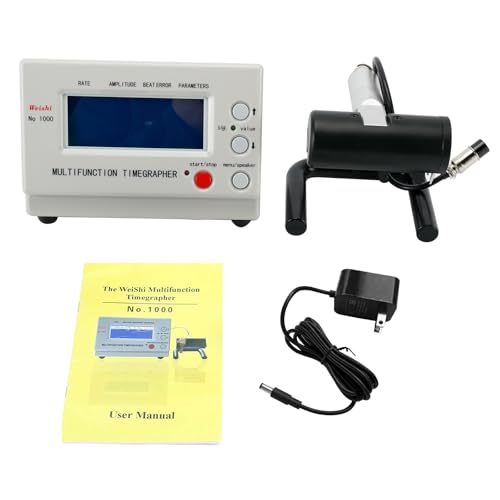
- Measures rate, amplitude, and beat error
- Six testing positions with adjustable sampling
- 3-inch LCD and 110V-220V US plug
Best For: Mechanical-watch collectors and hobbyists
Professional Pick
MechanBINGOX 6-Position Timegrapher

- Real-time rate, amplitude, and beat-error readings
- Six-position mechanical-watch analysis
- Supports 18,000-36,000 BPH movements
Best For: Watchmakers and serious mechanical-watch collectors
Coaxial-Friendly Choice

- Designed for mechanical and coaxial watches
- Larger LCD than the NO.1000
- 100V-240V input with exchangeable plugs
Best For: Collectors and watchmakers testing coaxial movements
Compact Analyzer
Portable Mechanical Watch Timegrapher

- Measures deviation, beat error, amplitude, and frequency
- Shows waveform graphs and dotted lines
- Battery powered and weighs 116.5 g
Best For: Amateur users seeking portable diagnostics
Easy-Start Pick
No.1000 Mechanical Watch Timegrapher
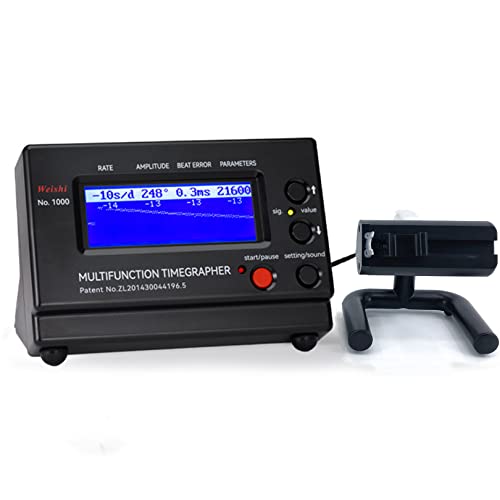
- Live LCD readings for rate, amplitude, and beat error
- Simple setup for collectors and hobbyists
- Supports most mechanical and coaxial watches
Best For: Collectors and hobbyists wanting an easy-to-use mechanical watch tester
Precision Pick
SWANSOFT No.1000 Professional Timegrapher

- Stated ±0.1s/d accuracy with 50-sample averaging
- Tests six positions and shows timing curves
- Detailed readings for amplitude, beat error, and lift angle
Best For: Watchmakers and enthusiasts performing detailed mechanical-watch diagnostics
Best Value Calibration Tool

- Real-time rate, amplitude, and beat-error readings
- Supports automatic and manual beat settings
- Includes sensor, adapter, manual, and cleaning cloth
Best For: Amateur watchmakers needing essential mechanical-watch testing
Best Precision Features
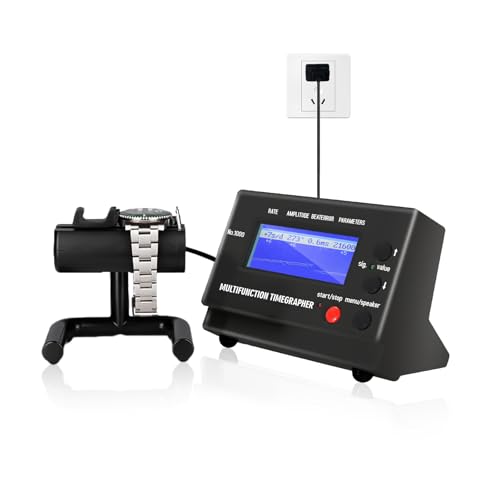
- Stated ±0.1s/d accuracy with averaging
- Color display shows timing curves and key metrics
- Tests up to six positions with adjustable sampling
Best For: Advanced mechanical-watch diagnostics and calibration
Best Portable Design
Multifunctional Watch Tester No.1000
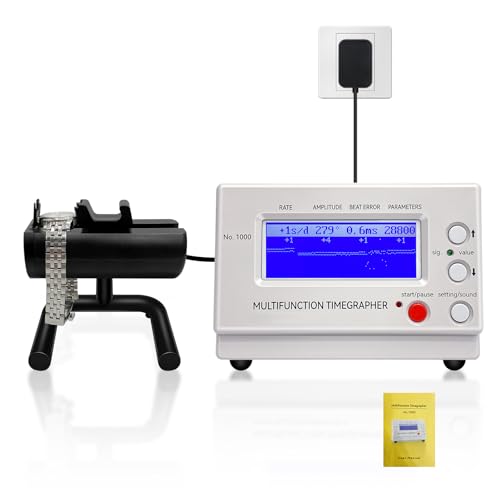
- Measures rate, amplitude, beat, polarity, and lift angle
- Compact body with acoustic sensing and color LCD
- Supports 100V–240V input and one to six directions
Best For: Portable mechanical-watch testing and compact workbenches
Best Value Starter – YaeTek NO.1000 Timegrapher
If you want a watch timing machine under 200 for basic mechanical-watch testing, the YaeTek NO.1000 offers a practical feature set. It automatically calculates rate, amplitude, and beat error, while its LCD shows live readings and moving timing lines.
Best For: Mechanical-watch collectors and hobbyists who want straightforward timing checks.
Pros:
- Measures rate, amplitude, and beat error automatically.
- Offers six adjustable testing positions.
- Supports selectable sampling periods from 2 to 60 seconds.
- Uses a 110V-220V US plug and displays results on a 3-inch LCD.
Cons:
- Designed for mechanical-watch testing rather than quartz watches.
- Its listed amplitude range is 275 to 315.
The NO.1000 is a sensible entry-level choice for users who need core timegrapher readings without a complicated setup. Its automatic signal adjustment and adjustable sampling periods make routine checks easier.
Professional Pick – MechanBINGOX 6-Position Timegrapher
For shoppers comparing a watch timing machine under 200 with a more professional feature set, this MechanBINGOX timegrapher provides real-time rate, amplitude, and beat-error measurements. Its six-position analyzer helps reveal how a mechanical movement performs in different orientations.
Best For: Watchmakers, repair shops, collectors, and enthusiasts evaluating automatic or mechanical watches.
Pros:
- Displays rate, amplitude, beat error, and timing curves in real time.
- Tests dial-up, dial-down, and four crown positions.
- Supports common frequencies from 18,000 to 36,000 BPH.
- Uses an easy-to-read LCD display.
Cons:
- Not designed for quartz watches.
- The supplied information does not specify its power requirements.
This model is a strong fit when position-to-position consistency matters. Its broad mechanical-watch compatibility and live diagnostics make it more suitable for regular movement assessment than occasional curiosity checks.
Coaxial-Friendly Choice – NO.1900 LCD Timegrapher
OTOOLWORLD New Coaxial MTG Watch Tester Timing Multifunction Timegrapher LCD Screen NO.1900
Check Price On AmazonThe NO.1900 is worth considering if you need a watch timing machine under 200 for mechanical and coaxial watches. It has a larger LCD screen than the NO.1000, and the supplied notes specifically highlight improved operation with coaxial movements.
Best For: Watch collectors and watchmakers who want a larger display and coaxial-watch compatibility.
Pros:
- Works with almost all mechanical watches and coaxial watches.
- Features a larger screen than the NO.1000.
- Uses a 100V-240V power range.
- Includes exchangeable mini plugs for several regions.
Cons:
- The supplied notes do not list specific rate, amplitude, or beat-error ranges.
- It is a corded-electric device rather than a battery-powered tester.
Choose the NO.1900 when display size and coaxial-watch support are higher priorities. Its wide input-voltage range and interchangeable plug options also make it convenient for users in different regions.
Compact Analyzer – Portable Mechanical Watch Timegrapher
This compact tester offers a useful alternative for shoppers seeking a watch timing machine under 200 with broad diagnostic information. It measures daily deviation, beat error, amplitude, frequency, dotted lines, and waveform graphs, while its plastic housing keeps the unit lightweight.
Best For: Amateur users and repair hobbyists who value portability and expanded waveform analysis.
Pros:
- Measures daily deviation, beat error, amplitude, and frequency.
- Displays dotted lines and waveform graphs.
- Includes rise-angle settings and anti-magnetization features.
- Lightweight at 116.5 g with a rugged plastic housing.
Cons:
- Listed for mechanical hand-wind watches, limiting movement compatibility.
- Uses plastic for the housing, band, and crystal.
- The supplied notes do not specify the supported BPH range or testing positions.
Its small, battery-powered design makes this model appealing for portable checks and amateur experimentation. Consider it when detailed signal visualization matters more than a clearly documented multi-position setup.
Easy-Start Pick – No.1000 Mechanical Watch Timegrapher
KINSANINC Watch Tester Timegrapher No.1000, Watch Timing Machine Calabration for Mechanical Watches
Check Price On AmazonIf you want a straightforward watch timing machine under 200, this No.1000 model is designed for easy setup and immediate use. Its LCD displays live rate, amplitude, beat error, beat, and lift-angle readings, making it practical for routine checks on mechanical watches.
Best For: Watch collectors, hobbyists, and users who want a simple tester that can also support professional work.
Pros:
- Displays key timing measurements on an LCD screen.
- Ready to use right out of the box.
- Works with almost all mechanical watches, including coaxial watches.
- Automatically adjusts the optimal signal level for different watches.
Cons:
- Designed for mechanical watches rather than quartz models.
- Corded electric power limits portability.
This is a practical value option for buyers prioritizing simple operation and core timing data. The included one-year warranty and available customer service add reassurance for first-time users.
Connectivity Pick – USB/RS232 Watch Timing Machine
This watch timing machine under 200 stands out for measurement flexibility and computer connectivity. It provides readings such as daily rate, signal value, beat-related data, frequency, and waveform display, while USB/RS232 transfer supports moving results to compatible computers.
Best For: Users who want adjustable calibration controls, data transfer, and a compact instrument for varied watch sizes.
Pros:
- Offers multifunctional timing and waveform analysis.
- Supports USB/RS232 data transfer to tablets, laptops, and desktops.
- Sliding, removable jaws accommodate different dial sizes.
- Power indicator light provides quick operating confirmation.
Cons:
- The supplied notes do not specify a warranty or included accessories.
- Computer data transfer may require a compatible connection and device.
Choose this model if workflow integration matters as much as on-device readings. Its adjustable holder and transfer features make it particularly appealing for users who plan to record or review calibration data digitally.
Precision Pick – SWANSOFT No.1000 Professional Timegrapher
For buyers seeking a more advanced watch timing machine under 200, the SWANSOFT No.1000 emphasizes precision and diagnostic detail. It offers stated accuracy of ±0.1 seconds per day with a 50-sample average, plus live readings for rate, amplitude, beat error, lift angle, and timing curves.
Best For: Watchmakers, technicians, and enthusiasts who need detailed mechanical-movement analysis and multiple testing positions.
Pros:
- Provides ±0.1s/d stated accuracy with a 50-sample average.
- Measures amplitude, beat error, lift angle, and timing curves.
- Supports six testing positions and sampling cycles from 2 to 60 seconds.
- Includes 12-month support and a stated satisfaction guarantee.
Cons:
- Only suitable for mechanical movements and does not support quartz watches.
- At 1.27 kg, it is less convenient to move than a very compact tester.
- Its professional feature set may be more than casual users need.
This is the strongest choice here for detailed bench diagnostics. Its adjustable lift angle, broad measurement range, and six-position testing make it better suited to serious servicing than basic spot checks.
Best Value Calibration Tool – Watch Timegrapher No.1000
If you need a watch timing machine under 200 for routine mechanical-watch checks, this No.1000 model covers the core measurements in a straightforward desktop format. Its LCD displays rate, amplitude, beat error, beat, and lift angle in real time, while automatic and manual beat settings support a broad range of movements.
Best For: Amateur watchmakers and technicians who want a practical mechanical-watch calibration tool with the essential accessories included.
Pros:
- Displays rate, amplitude, beat error, beat, and lift angle.
- Supports automatic beats from 12,000 to 43,200, plus manual settings.
- Includes the timegrapher, sensor, US adapter, manual, and cleaning cloth.
- Designed for mechanical watch testing and calibration.
Cons:
- It is intended for mechanical watches rather than quartz models.
- Requires AC power and is not water resistant.
This is a sensible entry-level bench instrument when you want broad beat support and clear live readings without adding unnecessary complexity. The included sensor and accessories make it ready for a small watchmaking workspace.
Best Precision Features – SWANSOFT Timegrapher No.1000
For shoppers comparing a watch timing machine under 200, the SWANSOFT No.1000 stands out for its stated ±0.1 seconds-per-day accuracy with 50-sample averaging. It adds color-screen graphs, adjustable sampling, six-position testing, and detailed movement measurements for more advanced diagnostics.
Best For: Watchmakers, technicians, and experienced enthusiasts who want extensive timing data and position-based testing for mechanical movements.
Pros:
- States ±0.1s/d accuracy with a 50-sample average and a ±999s/d range.
- Measures rate, amplitude, beat error, lift angle, and timing curves.
- Supports two- to 60-second sampling cycles and six positions.
- Includes a sensor, US adapter, professional manual, and 12-month support.
Cons:
- Only suitable for mechanical movements and does not support quartz watches.
- The supplied specifications contain inconsistent watch-style details, so focus on the tester’s stated functions.
Among these options, this model offers the most diagnostic-oriented feature set. Its adjustable sampling, color display, and multi-position support are useful when basic rate checking is not enough and you need a fuller view of movement performance.
Best Portable Design – Multifunctional Watch Tester No.1000
This compact watch timing machine under 200 is built for users who want broad mechanical-watch testing in a portable format. It measures daily rate, amplitude, beat, lift angle, polarity, and period, with acoustic sensing, a color LCD, and wide-voltage input for flexible bench use.
Best For: Watch enthusiasts, makers, and technicians who value portability, detailed measurements, and compatibility with 100V–240V power.
Pros:
- Tests daily rate, beat amplitude, beat, lift angle, polarity, and period.
- Offers ±999s/d measurement range with 0.1s/d resolution.
- Supports 2- to 60-second sampling and one to six directional measurements.
- Compact design, acoustic sensor, and 100V–240V ±10% input improve flexibility.
Cons:
- Designed for manual-winding mechanical watches according to the supplied details.
- The listing does not specify included accessories beyond detailed instructions.
This model is a strong fit when workspace or portability matters. Its measurement range and small footprint make it practical for routine diagnosis, while the wide-voltage input is helpful for users who test watches in different locations.
How We Picked the Best Watch Timing Machine Under 200
We evaluated these timegraphers around the measurements that matter most when checking a mechanical watch: daily rate, amplitude, beat error, beat frequency, and beat lines. We also considered whether each unit includes a stable acoustic pickup, a readable LCD, multiple testing positions, and straightforward controls.
At this price, these machines are primarily diagnostic and regulation aids rather than fully professional laboratory instruments. Results can vary with watch position, lift-angle settings, background noise, magnetism, and the condition of the movement. The strongest options offer useful readings consistently and make comparisons between positions easy.
Quick Comparison
Most models in this roundup are multifunction timegraphers with similar core readouts. The main differences are presentation, controls, pickup design, and included accessories. No.1000-style testers are generally aimed at practical watchmaker use, while models with larger or more modern displays may be easier for beginners to read.
- Best for general testing: Choose a multifunction unit that displays rate, amplitude, and beat error together.
- Best for regulation work: Prioritize stable acoustic pickup and clear beat-error readings.
- Best for beginners: Look for simple controls, an LCD with strong contrast, and automatic beat detection.
- Best for repeated checks: Select a model with dependable positioning and easy switching between test modes.
Key Buying Factors for a Watch Timing Machine Under 200
Measurements and Accuracy
Confirm that the tester displays the measurements you actually need. Daily rate shows whether a watch is running fast or slow; beat error indicates balance-spring symmetry; amplitude helps identify potential mechanical or servicing issues. Treat readings as guidance and compare multiple runs rather than relying on one result.
Pickup and Noise Handling
An acoustic sensor must make reliable contact with the watch or holder. A secure pickup rail or clip can reduce interruptions, while better noise rejection helps in a home workshop. Keep the machine away from fans, conversations, and vibrating surfaces during testing.
Positions and Lift-Angle Settings
Testing dial-up, dial-down, crown-up, and other positions can reveal how a movement behaves when worn. Adjustable lift-angle settings are valuable when working with different calibers, because an incorrect setting can make amplitude readings misleading.
Display and Everyday Usability
Choose a screen that is readable at your normal bench distance. Straightforward menus, responsive buttons, and clear symbols matter more than a long feature list. Also check whether the included power adapter is suitable for your region and whether replacement accessories are easy to find.
Who Should Buy Which Watch Timing Machine Under 200?
Hobbyists and collectors should choose a simple multifunction tester with clear rate and beat-error readings. It can help verify a watch’s condition and monitor changes over time.
Beginning watchmakers should prioritize adjustable settings, multiple positions, and a stable pickup. These features support basic regulation practice without requiring a large investment.
Experienced repairers on a budget may prefer the model with the best combination of consistent sensing, readable data, and convenient controls. If you service many watches or need documented precision, consider a professional-grade timegrapher later.