
Finding a dependable timegrapher does not require a large professional-equipment budget. The best watch timing machines under $50 can provide useful readings for rate, amplitude, beat error, and beat frequency when regulating or troubleshooting mechanical watches.
This roundup compares affordable testers with practical features such as acoustic pickups, LCD displays, USB-C connectivity, demagnetization, and multifunction operation, so you can choose the right tool for your bench.
Page Contents
- Best 10 Watch Timing Machines Under 50 Picks for 2026
- USB-Ready Calibration Pick – Adjustable Watch Timegrapher
- Noise-Controlled Choice – Mechanical Watch Timegrapher Tester
- USB-C Convenience Pick – Wristwatch Timegrapher
- Multi-Function Repair Tool – Quartz Tester and Demagnetizer
- Compact Professional Pick – NO.1000 Mechanical Watch Timegrapher
- Best Display Upgrade – No.1900 LCD Watch Timegrapher
- Most Adjustable Testing – YaeTek NO.1000 Timegrapher
- Best Easy-to-Use Pick – Watch Tester Timegrapher No.1000
- Best Multifunctional Pick – Multifunctional Watch Tester Timegrapher
- Best Precision Pick – SWANSOFT Timegrapher No.1000
- How We Picked the Best Watch Timing Machines Under 50
- Quick Comparison
- Key Buying Factors for Watch Timing Machines Under 50
- Who Should Buy Which Watch Timing Machines Under 50?
Best 10 Watch Timing Machines Under 50 Picks for 2026
Noise-Controlled Choice
Mechanical Watch Timegrapher Tester

- Measures rate, amplitude, beat data, and lift angle
- Noise-reduction components support signal processing
- Hard-plastic housing is designed for reliability
Best For: Amateurs checking mechanical-watch performance
USB-C Convenience Pick

- Includes a USB Type-C data cable
- Measures rate, amplitude, beat error, and waveform
- Enclosed cavity helps reduce testing noise
Best For: Users prioritizing USB-C connectivity
Multi-Function Repair Tool
Quartz Tester and Demagnetizer

- Combines quartz, pulse, battery, and demagnetizer functions
- Adjustable demagnetization speed
- Runs on two 1.5V AA batteries, not included
Best For: Repair kits handling quartz and battery tasks
Compact Professional Pick
NO.1000 Mechanical Watch Timegrapher

- Tests almost all mechanical watches
- Supports coaxial watches
- Compact corded-electric design
Best For: Collectors and watchmakers wanting a compact general-purpose tester
Best Display Upgrade

- Displays five live timing readings
- Works with coaxial mechanical watches
- Includes one-year warranty
Best For: Users wanting a detailed LCD readout for mechanical-watch testing
Most Adjustable Testing
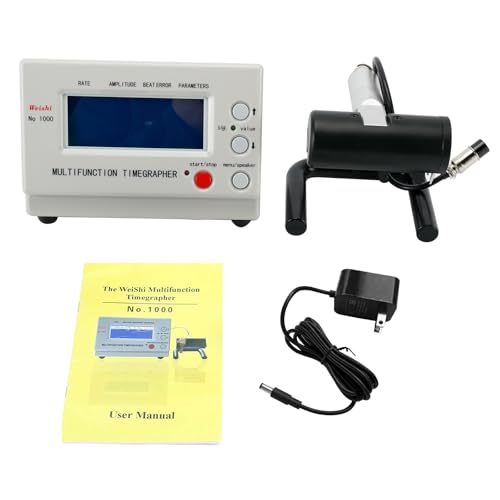
- Automatically calculates key timing readings
- Offers six testing positions
- Supports 2- to 60-second sampling
Best For: Collectors wanting flexible testing settings and visual LCD feedback
Best Easy-to-Use Pick
Watch Tester Timegrapher No.1000
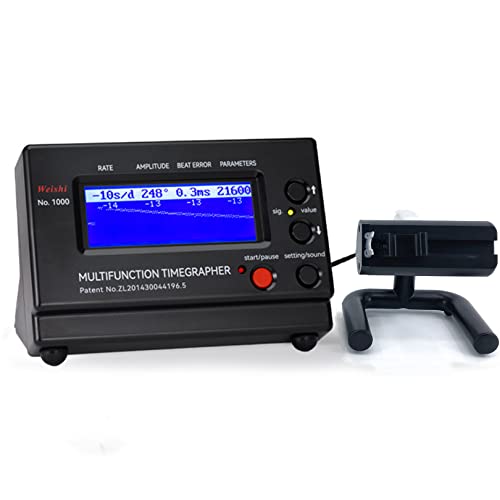
- LCD displays rate, amplitude, beat error, beat, and lift angle.
- Automatically adjusts signal level between watches.
- One-year warranty with customer support.
Best For: Collectors and hobbyists testing most mechanical watches
Best Multifunctional Pick
Multifunctional Watch Tester Timegrapher
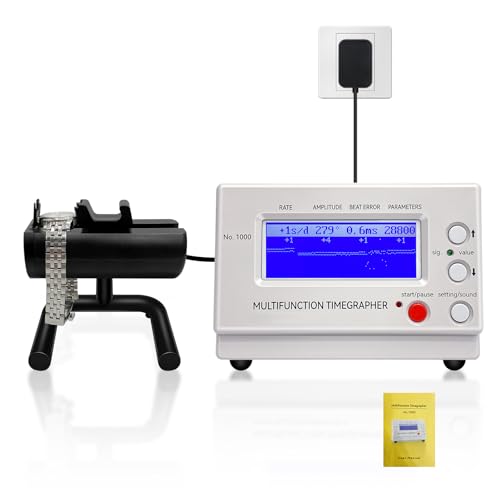
- Tests daily rate, amplitude, polarity, beat, lift angle, and period.
- Supports 2–60-second sampling and one to six directions.
- Uses a color LCD and accepts 100V–240V input.
Best For: Detailed mechanical-watch diagnostics and calibration work
Best Precision Pick

- Provides stated ±0.1 seconds-per-day accuracy with 50-sample averaging.
- Tests up to six positions and displays live timing curves.
- Measures rate, amplitude, beat error, and adjustable lift angle.
Best For: Detailed multi-position calibration of mechanical watches
USB-Ready Calibration Pick – Adjustable Watch Timegrapher
For shoppers comparing watch timing machines under 50, this multifunction timegrapher stands out for its adjustable mounting jaws and broad measurement set. It can display rate, amplitude, beat-related data, frequency, polarization, oscillation, and waveforms, while USB/RS232 connectivity supports computer data transfer.
Best For: Watch hobbyists who want flexible sizing and PC-connected measurements.
Pros:
- Measures multiple mechanical-watch timing indicators, including daily rate, amplitude, and beat error.
- Removable sliding jaws accommodate different dial sizes.
- Supports data transfer to tablets, laptops, and desktops through USB/RS232 connectivity.
- Red power indicator makes operation status easy to monitor.
Cons:
- The supplied notes do not specify included computer software.
- Its compact 3.94-by-2.36-by-1.97-inch body may limit workspace around larger watches.
This is a versatile choice when adjustable positioning and computer-friendly reporting matter more than a basic, single-purpose tester.
Noise-Controlled Choice – Mechanical Watch Timegrapher Tester
Among watch timing machines under 50, this tester is aimed at amateur users who want a broad mechanical-watch diagnostics readout. Its design combines ceramic filter capacitors, signal processing hardware, and foam intended to reduce noise and shock during measurement.
Best For: Amateur watch users seeking a dedicated mechanical-watch timing tester.
Pros:
- Measures daily rate, polarization, amplitude, frequency, waveform, and lift angle.
- Uses three ceramic filter capacitors and signal-processing components for noise management.
- Hard-plastic housing is described as rugged and reliable.
- Digital display provides a direct readout.
Cons:
- The supplied details identify it as battery powered without specifying battery type or runtime.
- The notes do not mention USB or computer data transfer.
- Water resistance is listed, but no specific rating is provided.
Its measurement range and noise-reduction construction make it a practical standalone option for learning and routine mechanical-watch checks.
USB-C Convenience Pick – Wristwatch Timegrapher
DBEIXIWEI Watch Timegrapher with USB Type-C Data Cable Wristwatch Timing Machine Calibration Tool
Check Price On AmazonThis USB-C timegrapher is a focused option for shoppers looking at watch timing machines under 50. It measures rate, amplitude, beat error, frequency, lift angle, and waveform, with an enclosed sensor cavity and integrated amplifier circuit intended to reduce noise.
Best For: Watch hobbyists who prefer USB-C connectivity and a compact calibration tool.
Pros:
- Includes a USB Type-C data cable.
- Measures several key timing parameters, including rate, amplitude, and beat error.
- Enclosed noise-reduction and sound-insulation cavity supports testing.
- Microelectronic test circuitry is designed not to magnetize watches during testing.
Cons:
- The supplied notes do not specify compatible data-transfer software or operating systems.
- Its housing is plastic rather than metal.
- No water resistance is provided.
Choose this model when the included USB-C cable and broad timing readouts are priorities, while keeping expectations practical about software details.
Multi-Function Repair Tool – Quartz Tester and Demagnetizer
Unlike dedicated mechanical timegraphers, this compact tool combines demagnetization, quartz testing, pulse testing, and battery checking. It is worth considering among watch timing machines under 50 if your repair kit needs broader maintenance functions rather than mechanical timing analysis alone.
Best For: Watch repair workers needing quartz, battery, pulse, and demagnetization functions in one tool.
Pros:
- Combines adjustable-speed demagnetization with quartz movement testing.
- Checks battery capacity and supports pulse testing without opening the watch case.
- Compact, lightweight design weighs about 151 grams.
- Useful as a multifunction tool for watchmakers and repair workers.
Cons:
- Two 1.5V AA batteries are required and are not included.
- It is not described as a full mechanical-watch rate, amplitude, or beat-error timegrapher.
- The supplied dimensions appear inconsistent with the listed package size, so buyers should verify fit before ordering.
This is the better match for mixed watch-service tasks, but choose a dedicated timegrapher if detailed mechanical movement regulation data is your main goal.
Compact Professional Pick – NO.1000 Mechanical Watch Timegrapher
If you need watch timing machines under 50 for routine mechanical-watch checks, the NO.1000 is a compact, corded-electric option designed to test almost all mechanical watches, including coaxial models. Its straightforward format suits both collectors and professional watchmakers.
Best For: Collectors and watchmakers who want a compact, general-purpose mechanical-watch tester.
Pros:
- Supports testing for almost all mechanical watches.
- Works with coaxial watches.
- Compact modern design measuring 6.77 x 1.57 x 4.49 inches.
- Popular with professional watchmakers and watch collectors.
Cons:
- Uses corded electric power.
- The supplied notes do not list the display measurements or sampling options.
The NO.1000 is a practical entry point when compact size and broad mechanical-watch compatibility matter more than a detailed list of advanced display features.
Best Display Upgrade – No.1900 LCD Watch Timegrapher
Among watch timing machines under 50, the No.1900 stands out for its larger LCD screen and live readings. It displays rate, amplitude, beat error, beat, and lift angle, making it a useful choice for collectors, hobbyists, and professional users who want more information at a glance.
Best For: Hobbyists and watch collectors who prioritize a larger, more detailed live display.
Pros:
- LCD screen shows rate, amplitude, beat error, beat, and lift angle.
- Designed to work with almost all mechanical watches, including coaxial models.
- Described as easy to use out of the box.
- Includes a one-year warranty and customer service support.
Cons:
- Uses AC power rather than battery operation.
- Its square case has a mineral-glass crystal, but the unit is not water resistant.
The No.1900 is the strongest fit here for users who want a clearer, more informative readout without giving up broad mechanical-watch compatibility.
Most Adjustable Testing – YaeTek NO.1000 Timegrapher
For buyers comparing watch timing machines under 50, the YaeTek NO.1000 offers a useful mix of automated readings and adjustable test settings. Its LCD shows rate, amplitude, and beat error in real time, while six testing positions and selectable sampling periods provide more control over measurements.
Best For: Watch collectors who want adjustable test positions, sampling periods, and real-time visual feedback.
Pros:
- Automatically calculates rate, amplitude, and beat error.
- Offers six adjustable testing positions.
- Provides sampling periods from 2 to 60 seconds.
- Uses a 110V-220V US plug and displays readings on an LCD screen.
Cons:
- At 1.37 kg, it is less lightweight than a highly portable tester.
- The supplied notes identify the model as NO.1000, so feature comparisons with the newer No.1900 should be considered carefully.
The YaeTek is appealing when measurement flexibility matters, especially for users who want to compare results across positions and sampling intervals.
Best Easy-to-Use Pick – Watch Tester Timegrapher No.1000
KINSANINC Watch Tester Timegrapher No.1000, Watch Timing Machine Calabration for Mechanical Watches
Check Price On AmazonIf you want watch timing machines under 50 for straightforward mechanical-watch checks, this No.1000 model focuses on the core readings. Its LCD displays rate, amplitude, beat error, beat, and lift angle, while automatic signal adjustment helps simplify testing across different watches.
Best For: Watch collectors, hobbyists, and users who want an easy-to-use tester for most mechanical watches, including coaxial watches.
Pros:
- Shows live rate, amplitude, beat error, beat, and lift angle readings.
- Automatically adjusts the optimal signal level for different watches.
- Designed for nearly all mechanical watches and coaxial watches.
- Includes a one-year warranty and customer support.
Cons:
- Only intended for mechanical watches, not quartz models.
- The supplied details identify it as a corded-electric unit, so it is not presented as battery-powered.
This is a practical entry-level-style choice when simple operation and essential timing data matter more than an extensive list of advanced controls.
Best Multifunctional Pick – Multifunctional Watch Tester Timegrapher
Among watch timing machines under 50, this multifunctional timegrapher stands out for broader measurement options and fine-grained sampling. It tests daily rate, amplitude, polarity, beat, lift angle, and period, with a color LCD and manual controls for special beat frequencies.
Best For: Watchmakers, technicians, makers, and enthusiasts who need more detailed mechanical-movement diagnostics in a compact bench tool.
Pros:
- Measures daily rate, beat amplitude, polarity, beat, lift angle, and period.
- Offers 2–60-second sampling and supports one to six directional measurements.
- Provides a ±999 seconds-per-day range with 0.1 seconds-per-day resolution.
- Supports 100V–240V input and has a lightweight, portable design.
Cons:
- Designed for manual-winding mechanical watches, so it is not a general quartz tester.
- The feature set may be more than casual users need for occasional checks.
Choose this model when measurement flexibility is a priority. Its special-frequency selection, polarity readings, and high-density sampling make it the most technically focused option in this group.
Best Precision Pick – SWANSOFT Timegrapher No.1000
For shoppers comparing watch timing machines under 50, the SWANSOFT No.1000 emphasizes precision measurement and multi-position testing. It displays rate, amplitude, beat error, lift angle, and timing curves, with adjustable sampling and lift-angle settings for mechanical movements.
Best For: Watchmakers, technicians, and enthusiasts who want detailed readings across up to six positions and a wide daily-rate range.
Pros:
- Offers stated accuracy of ±0.1 seconds per day with a 50-sample average.
- Measures a ±999 seconds-per-day range for antique or faulty watches.
- Supports six positions, 2–60-second sampling cycles, and manual special-frequency selection.
- Displays live graphs alongside rate, amplitude, beat error, and lift angle.
Cons:
- Only suitable for mechanical movements and does not support quartz watches.
- Its professional controls and diagnostics may be unnecessary for basic hobby use.
- The supplied details describe it as a bench instrument rather than a battery-powered tester.
This is the strongest fit for users who value precision and diagnostic depth. Its position testing and live timing curves make it especially useful for more systematic calibration work.
How We Picked the Best Watch Timing Machines Under 50
We focused on the features that matter most when evaluating mechanical watch performance: readable timing data, useful beat-frequency settings, reliable acoustic pickup, straightforward controls, and compatibility with common mechanical movements. We also considered whether each machine adds practical extras, such as USB connectivity, demagnetization, battery testing, or a compact design suitable for a home workbench.
At this price, these instruments should be treated as diagnostic and regulating aids rather than substitutes for a fully professional timing system. Accuracy can vary with positioning, movement condition, microphone placement, power quality, and the quality of the included accessories.
Quick Comparison
| Feature | What to look for | Why it matters |
|---|---|---|
| Timing measurements | Rate, amplitude, beat error, and beat frequency | Shows how consistently a movement is running |
| Pickup system | Acoustic rail or external microphone | Helps capture escapement sounds clearly |
| Display | Clear LCD or illuminated readout | Makes readings easier to interpret at the bench |
| Connectivity | USB or USB-C power/data support | Can simplify powering or recording results |
| Extra functions | Demagnetizer or battery tester | Adds value for broader watch servicing tasks |
Key Buying Factors for Watch Timing Machines Under 50
Measurement Coverage
Prioritize a model that reports rate, amplitude, and beat error if you plan to regulate watches. Rate indicates whether the watch is gaining or losing time, while amplitude offers a useful indication of movement energy and friction. Beat error can help identify an uneven tick-and-tock relationship.
Movement and Beat Compatibility
Check the supported beat frequencies before buying. Many mechanical movements use common settings such as 18,000, 21,600, 28,800, or 36,000 beats per hour, but not every inexpensive tester handles every option automatically. Manual selection may be necessary.
Ease of Use and Readability
A clear display, simple controls, and a stable watch holder make more difference than a long feature list. Look for a pickup rail or microphone that keeps the watch securely positioned and reduces noise during testing.
Power and Included Accessories
USB-powered machines are convenient for a home bench, especially when a USB-C cable is included. Confirm whether the package includes the power adapter, acoustic pickup, watch support, and any required cables; low-cost listings may vary by seller.
Who Should Buy Which Watch Timing Machines Under 50?
Choose a basic No. 1000-style timegrapher if you mainly need rate, amplitude, and beat-error readings for routine regulation. These models are often the simplest choice for hobbyists and first-time users.
Choose a USB-C model if flexible desktop power and modern connectivity are more important than extra functions. It suits compact workspaces and occasional testing.
Choose a multifunction tester if you also want demagnetization or battery-related functions. These added tools can be useful for broader maintenance, though they may not replace dedicated professional equipment.
Choose a model with a clearer LCD and stronger stand if you test watches frequently. Better visibility and stability can make repeated measurements faster and easier to compare.