
Mechanical watches can appear accurate while gaining or losing time in ways that are difficult to diagnose by eye. A watch timing machine gives hobbyists measurable readings for rate, amplitude, beat error, and beat frequency, making regulation and troubleshooting more systematic.
We selected 10 timegraphers with features suited to home benches, including LCD displays, sound visualization, multiple lift-angle settings, and calibration functions. The guide below explains which specifications matter most before you buy.
Page Contents
- Best 10 Watch Timing Machines for Hobbyists Picks for 2026
- Precision Diagnostic Pick – SWANSOFT No.1000 Timegrapher
- Large-Screen Coaxial Choice – MTG No.1900 LCD Timegrapher
- Complete Hobbyist Analyzer – MechanBINGOX Professional Timegrapher
- Compact Essential – No.1000 Multifunction Timegrapher
- Best Visual Testing Pick – Dual-Line Watch Timegrapher
- Best Straightforward Starter – No.1000 Mechanical Watch Tester
- Best Larger-Screen Option – No.1900 Multifunction Timegrapher
- Best Value Timegrapher – Howkun WEISHI No.1000
- Best Large-Screen Pick – SWANSOFT No.1900 Timegrapher
- Best Precision Features – Multifunctional No.1000 Timegrapher
- How We Picked These Watch Timing Machines for Hobbyists
- Quick Comparison
- Key Buying Factors for Watch Timing Machines for Hobbyists
- Who Should Buy Which Watch Timing Machines for Hobbyists?
Best 10 Watch Timing Machines for Hobbyists Picks for 2026
Precision Diagnostic Pick

- Stated ±0.1 s/d accuracy with 50-sample averaging
- Color LCD shows rate, amplitude, beat error, and curves
- Six-position testing with adjustable lift angle
Best For: Serious hobbyists wanting detailed mechanical-watch diagnostics
Large-Screen Coaxial Choice

- Larger LCD than the No.1000
- Works with almost all mechanical and coaxial watches
- 100V–240V input with multiple regional plug options
Best For: Collectors who prioritize readability and coaxial-watch testing
Complete Hobbyist Analyzer
MechanBINGOX Professional Timegrapher

- Real-time rate, amplitude, beat error, and curve readings
- Six-position testing for orientation comparisons
- Supports 18,000–36,000 BPH mechanical movements
Best For: Collectors and hobbyists wanting broad, real-time movement checks
Compact Essential
No.1000 Multifunction Timegrapher

- Tests almost all mechanical and coaxial watches
- Compact 6.77 × 1.57 × 4.49-inch design
- Corded, CE-specified multifunction tester
Best For: Home users wanting a compact basic mechanical-watch tester
Best Visual Testing Pick

- Real-time rate, amplitude, and error display
- Six adjustable testing positions
- 2- to 60-second sampling cycles
Best For: Hobbyists wanting detailed visual movement analysis
Best Straightforward Starter
No.1000 Mechanical Watch Tester
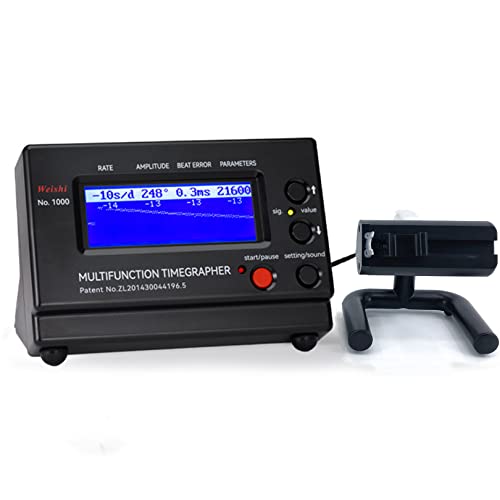
- Live LCD timing measurements
- Automatic signal-level adjustment
- Works with most mechanical and coaxial watches
Best For: Beginners and collectors seeking simple operation
Best Larger-Screen Option
No.1900 Multifunction Timegrapher

- Larger LCD for live readings
- Displays five core timing measurements
- Supports mechanical and coaxial watches
Best For: Hobbyists prioritizing readability and broad compatibility
Best Value Timegrapher

- Measures rate, amplitude, beat error, and beat number
- Offers six positions and 2–60 second sampling
- Compact 1.7 kg unit with blue LCD display
Best For: Hobbyists seeking flexible mechanical-watch testing in a compact unit
Best Large-Screen Pick

- Features a larger high-resolution color LCD
- Shows rate, amplitude, beat error, beat, and lift angle
- Includes sensor, US adapter, and professional manual
Best For: Users who want clear readings and simple mechanical-watch testing
Best Precision Features
Multifunctional No.1000 Timegrapher
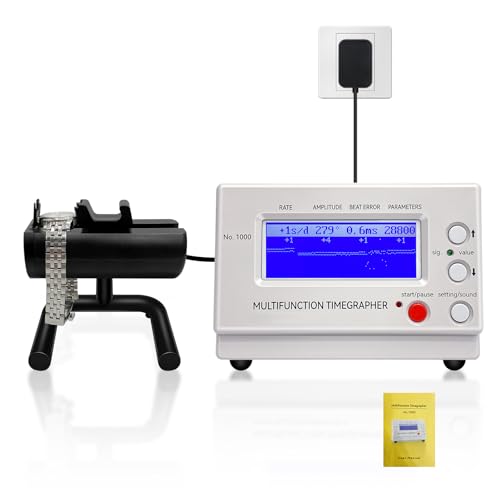
- Tests six key mechanical-movement characteristics
- Offers 0.1 s/d rate resolution and 196 sampling points
- Supports 1–6 positions and 100–240 V input
Best For: Experienced hobbyists seeking detailed movement diagnostics
Precision Diagnostic Pick – SWANSOFT No.1000 Timegrapher
For hobbyists seeking watch timing machines for hobbyists with detailed movement diagnostics, the SWANSOFT No.1000 combines precision measurement with broad adjustment options. It is designed for mechanical watches only, not quartz models.
Best For: Enthusiasts and watchmakers who want detailed readings, adjustable lift angles, and six-position testing.
Pros:
- Provides stated accuracy of ±0.1 seconds per day using a 50-sample average.
- Displays rate, amplitude, beat error, and timing curves on a color LCD.
- Supports six positions, 2–60-second sampling cycles, and adjustable 30°–70° lift angles.
- Includes 12-month support and a stated satisfaction guarantee.
Cons:
- Works only with mechanical movement watches.
- Its professional measurement range and controls may be more than casual users need.
This is the strongest fit when diagnostic depth matters. The combination of multi-position testing, live graphs, and fine measurement controls makes it a capable bench instrument for serious mechanical-watch hobbyists.
Large-Screen Coaxial Choice – MTG No.1900 LCD Timegrapher
OTOOLWORLD New Coaxial MTG Watch Tester Timing Multifunction Timegrapher LCD Screen NO.1900
Check Price On AmazonThe MTG No.1900 is a practical option among watch timing machines for hobbyists who value a larger display and coaxial-watch compatibility. Its corded design supports 100V–240V power and includes exchangeable regional mini plugs.
Best For: Collectors and hobbyists who want an easier-to-view LCD and support for coaxial mechanical watches.
Pros:
- Uses a larger LCD screen than the No.1000 for easier viewing and operation.
- Designed for almost all mechanical watches and works better with coaxial watches.
- Supports 100V–240V power with EU, AU, US, and Asia mini exchange plugs.
- Suitable for both professional watchmakers and watch collectors.
Cons:
- The supplied notes do not specify its measurement accuracy or displayed diagnostic metrics.
- It is a corded instrument rather than a portable, battery-powered tester.
Choose this model when screen size and coaxial compatibility are higher priorities than published precision specifications. Its broad voltage support also makes it convenient for users in different regions.
Complete Hobbyist Analyzer – MechanBINGOX Professional Timegrapher
The MechanBINGOX professional timegrapher offers the core measurements most hobbyists expect from watch timing machines for hobbyists: rate, amplitude, beat error, and timing curves. It supports common mechanical-watch beat frequencies and six testing positions.
Best For: Hobbyists and collectors who want straightforward real-time movement checks across multiple orientations.
Pros:
- Displays rate, amplitude, beat error, and timing curves in real time.
- Tests six positions, including dial, crown, and side orientations.
- Supports common 18,000, 21,600, 28,800, and 36,000 BPH frequencies.
- Designed for automatic and mechanical watches, repair shops, collectors, and enthusiasts.
Cons:
- Not designed for quartz watches.
- The supplied notes do not state a numerical accuracy specification.
This model focuses on useful, easy-to-read movement health checks rather than an unusually detailed feature list. Its six-position capability makes it a sensible choice for comparing performance as a watch changes orientation.
Compact Essential – No.1000 Multifunction Timegrapher
For hobbyists looking for a straightforward entry in watch timing machines for hobbyists, this compact No.1000 tester is built for mechanical watches, including coaxial models. Its corded format and compact dimensions suit a dedicated workbench.
Best For: Watch collectors and home users who need a basic multifunction tester for mechanical movements.
Pros:
- Tests almost all mechanical watches, including coaxial watches.
- Offers multifunction timegrapher operation for watch checking and collection maintenance.
- Compact dimensions measure approximately 6.77 × 1.57 × 4.49 inches.
- Uses corded power and carries CE specification compliance.
Cons:
- The supplied notes do not list specific readings, accuracy, or position-testing options.
- Compatible with mechanical watches only.
- Requires a corded power connection.
This is a sensible basic choice if you want a compact tester without relying on a larger professional feature set. Consider a more fully specified model if you need published accuracy figures or detailed multi-position analysis.
Best Visual Testing Pick – Dual-Line Watch Timegrapher
For hobbyists comparing watch timing machines for hobbyists, this model stands out for its dual-line sound visualization and six-position testing stand. It calculates rate, amplitude, and clock error in real time, with amplitude testing from 100° to 360°.
Best For: Home users and watch enthusiasts who want visual feedback, multiple testing positions, and flexible sampling cycles.
Pros:
- LED display shows speed, amplitude, and clock error in real time.
- Six adjustable orientations help simulate different wearing positions.
- Sampling cycles range from 2 to 60 seconds.
- Plug-and-play setup includes a rotatable sensor and beat-signal indicator.
Cons:
- The listed amplitude range and features may be more than casual users need.
- Its 3.94-inch, 2.86-pound design may require dedicated workspace.
This is a feature-rich choice for hobbyists who want more than basic readings. The visual signal display and position testing make it particularly useful for comparing movement behavior during home servicing or calibration.
Best Straightforward Starter – No.1000 Mechanical Watch Tester
KINSANINC Watch Tester Timegrapher No.1000, Watch Timing Machine Calabration for Mechanical Watches
Check Price On AmazonAmong watch timing machines for hobbyists, the No.1000 is a simple, ready-to-use option for checking core mechanical-watch measurements. Its LCD displays rate, amplitude, beat error, beat, and lift angle, while automatic signal adjustment helps when testing different watches.
Best For: Collectors and beginners who want an easy-to-operate tester for most mechanical and coaxial watches.
Pros:
- LCD screen provides live readings for key timing measurements.
- Designed for easy setup and operation out of the box.
- Automatically adjusts the optimal signal level for different watches.
- Includes a one-year warranty and customer-service support.
Cons:
- The notes do not mention multiple testing orientations or customizable sampling cycles.
- It uses a plastic case and corded electric power.
The No.1000 focuses on accessible operation rather than an expanded feature set. It is a practical entry point for hobbyists who primarily need live timing data and compatibility with a broad range of mechanical movements.
Best Larger-Screen Option – No.1900 Multifunction Timegrapher
The No.1900 is a practical candidate for shoppers comparing watch timing machines for hobbyists who prefer a larger display. It shows live rate, amplitude, beat error, beat, and lift angle, and is described as more precise than the No.1000 while remaining easy to use.
Best For: Hobbyists and collectors who want a straightforward tester with a larger LCD and support for coaxial watches.
Pros:
- Larger LCD screen displays core timing measurements in real time.
- Offers multifunction testing for rate, amplitude, beat error, beat, and lift angle.
- Works with almost all mechanical watches, including coaxial watches.
- Includes a one-year warranty and customer-service support.
Cons:
- The notes do not specify adjustable positions or sampling intervals.
- It uses AC power and is not water resistant.
Choose this model when readability is a priority and you want a larger-screen alternative to the No.1000. Its broad mechanical-watch compatibility and listed precision make it a balanced option for routine hobbyist testing.
Best Value Timegrapher – Howkun WEISHI No.1000
For hobbyists comparing watch timing machines, the Howkun WEISHI No.1000 offers a practical set of measurements in a compact desktop unit. It automatically calculates rate, amplitude, beat error, and beat number while supporting multiple sampling periods and testing positions.
Best For: Hobbyists and home watch-repair benches that need broad measurement options at a compact size.
Pros:
- Displays rate, amplitude, beat error, and beat number in real time.
- Supports sampling periods from 2 to 60 seconds for more flexible readings.
- Offers six testing positions and automatic selection for common beat rates.
- Includes a speaker with mute option and a blue graphic LCD screen.
Cons:
- Does not include a printer connection.
- The display is smaller than the upgraded No.1900 model.
- Its listed supply voltage is 90–220 V, so users should verify compatibility with their outlet.
With extensive beat-rate selection and adjustable testing positions, this is a versatile choice for hobbyists who want more control over basic mechanical-watch diagnostics without a large footprint.
Best Large-Screen Pick – SWANSOFT No.1900 Timegrapher
The SWANSOFT No.1900 is one of the more approachable watch timing machines for hobbyists because its larger, high-resolution color screen presents key readings clearly. It is designed specifically for mechanical watches and includes an intuitive interface, sensor, adapter, and professional manual.
Best For: Hobbyists, collectors, and technicians who prioritize readable on-screen data and straightforward operation.
Pros:
- Uses a larger, high-resolution color LCD screen than the No.1000 version.
- Displays rate, amplitude, beat error, beat, and lift angle.
- Designed for easy operation with a backlit screen and intuitive interface.
- Includes a one-year warranty and customer service support according to the supplied notes.
Cons:
- Only suitable for mechanical movement watches and does not support quartz watches.
- Uses a corded power source, limiting operation to locations with suitable power access.
- The supplied notes do not specify multiple testing positions or sampling-period options.
The No.1900 makes a strong case for users who value visibility and simplicity. Its larger display can make routine readings easier to interpret, though its mechanical-watch-only design limits its range of applications.
Best Precision Features – Multifunctional No.1000 Timegrapher
For hobbyists looking beyond basic rate checks, this multifunctional No.1000 covers daily rate, beat amplitude, polarity, beat, lift angle, and period. Its acoustic sensing, 0.1 s/d resolution, adjustable sampling, and wide-voltage input make it a capable option for a watchmaking workbench.
Best For: Enthusiasts and makers who want detailed mechanical-movement measurements and flexible setup options.
Pros:
- Tests daily rate, amplitude, polarity, beat, lift angle, and period.
- Provides a daily-rate range of ±999 s/d with 0.1 s/d resolution.
- Supports automatic standard-beat detection, manual special-beat selection, and 1–6 directional measurements.
- Uses a 192×64-pixel color LCD and supports 100–240 V ±10% input.
Cons:
- The supplied notes identify it for mechanical watches rather than quartz watches.
- Its more technical measurement set may be more than casual users need.
- No printer connection or time display is specified in the supplied information.
This model is a strong fit when measurement depth matters. The combination of fine rate resolution, polarity testing, high-density sampling, and portable construction gives experienced hobbyists useful diagnostic flexibility.
How We Picked These Watch Timing Machines for Hobbyists
We focused on timegraphers designed for mechanical-watch testing rather than general-purpose electronics. The selected models offer core measurements such as daily rate, amplitude, beat error, and beat frequency, with common 1000- and 1900-series designs represented. We also considered practical features including readable displays, adjustable lift angles, dual-line visualization, sound output, and controls that are approachable for hobby repair work.
Because listings and specifications can vary by seller, confirm the stated measurement range, supported beat frequencies, power requirements, and included accessories before ordering.
Quick Comparison
| Type | Best suited to | Features to look for |
|---|---|---|
| No. 1000 timegrapher | Most hobby benches | Core rate, amplitude, beat-error, and beat-frequency readings |
| No. 1900 timegrapher | Users wanting a larger or more advanced display | LCD screen, expanded controls, and broader adjustment options |
| Dual-line visualization model | Visual diagnosis | Clear trace patterns, sound visualization, and adjustable lift angle |
Key Buying Factors for Watch Timing Machines for Hobbyists
Measurements and Accuracy
At minimum, choose a machine that reports rate, amplitude, beat error, and beat frequency. A stable microphone and consistent readings are more useful than a long list of advanced functions. Look for clear documentation about accuracy and calibration, especially if you intend to regulate watches precisely.
Lift-Angle and Beat-Frequency Settings
Lift angle affects the amplitude calculation, so an adjustable setting is important when working on different movements. Support for common beat frequencies makes the tester more versatile. If you service vintage or unusual calibers, verify that the available ranges match your watches.
Display, Controls, and Sound
A bright LCD or readable screen helps when the machine sits on a crowded workbench. Visual traces can reveal beat irregularities, while headphone or speaker output may help identify noisy escapements. Simple controls are valuable if you are learning to interpret timing graphs.
Bench Setup and Reliability
Check the microphone position, watch holder, power adapter, footprint, and build quality. A stable holder reduces inconsistent readings. Also review replacement-part availability, seller support, and return terms before choosing a budget model.
Who Should Buy Which Watch Timing Machines for Hobbyists?
Choose a straightforward No. 1000 model if you mainly want dependable readings for routine regulation and basic diagnosis. Select a No. 1900 model if you prefer a larger LCD interface or want more visible controls and adjustment options. A dual-line visualization model is a good fit for learners who want to study timing traces and sound patterns. For occasional use, prioritize ease of setup and value; for frequent servicing, spend more on stable readings, flexible settings, and better documentation.