
Finding the best watch timing machine for home use can make mechanical-watch regulation and troubleshooting far more systematic. A good timegrapher shows useful performance data without requiring a full professional workshop setup.
We selected 10 timing testers covering popular No. 1000 and No. 1900 designs, LCD-equipped models, multifunction tools, and a quartz-focused option for different home repair needs and budgets.
Page Contents
- Best 10 Watch Timing Machine for Home Use Picks for 2026
- Best Value Home Timegrapher – YaeTek NO.1000 Watch Tester
- Compact Collector Pick – NO.1000 Multifunction Timegrapher
- Large-Screen Upgrade – No.1900 Watch Timegrapher
- Best for PC Data Transfer – Adjustable USB/RS232 Timegrapher
- Professional-Ready Pick – MTG NO.1900 Coaxial Timegrapher
- Beginner-Friendly Choice – TICFROG NO.1000 Watch Timegrapher
- Quartz Repair Multitool – Pilipane QD20 Quartz Movement Tester
- Best Display Upgrade – TICFROG No.1900 Timegrapher
- Best Precision Features – No.1000 Professional Timegrapher
- Best Straightforward Workbench Pick – No.1000 Watch Tester
- How We Picked the Best Watch Timing Machine for Home Use
- Quick Comparison
- Key Buying Factors for a Watch Timing Machine for Home Use
- Who Should Buy Which Watch Timing Machine for Home Use?
Best 10 Watch Timing Machine for Home Use Picks for 2026
Best Value Home Timegrapher
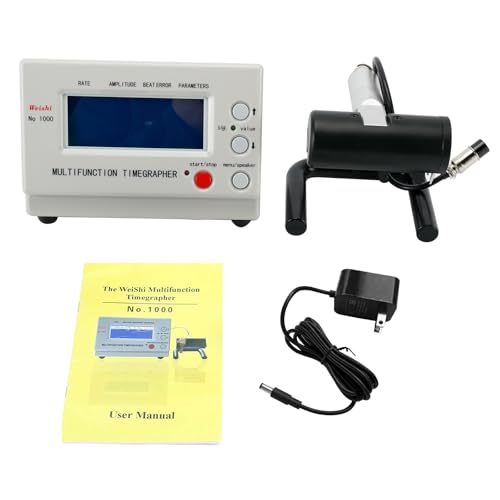
- Measures rate, amplitude, and beat error
- Six positions with 2–60 second sampling
- LCD display with visual tic-tock waveform
Best For: Mechanical-watch collectors wanting flexible home testing
Compact Collector Pick
NO.1000 Multifunction Timegrapher

- Tests almost all mechanical watches
- Supports coaxial testing
- Compact corded-electric design
Best For: Collectors seeking a simple mechanical-watch tester
Large-Screen Upgrade

- Shows five live timing measurements
- Larger screen than the No.1000
- Works with coaxial mechanical watches
Best For: Users wanting detailed readings on a larger display
Professional-Ready Pick
MTG NO.1900 Coaxial Timegrapher

- Larger LCD screen than the NO.1000
- Supports mechanical and coaxial watches
- 100V–240V power with exchange plugs
Best For: Collectors and experienced home users working with coaxial watches
Beginner-Friendly Choice
TICFROG NO.1000 Watch Timegrapher

- Measures rate, beat error, and amplitude
- Shows graphical and numerical results
- Includes sensor, adapter, manual, and cloth
Best For: Beginners testing mechanical watches at home
Quartz Repair Multitool
Pilipane QD20 Quartz Movement Tester

- Tests quartz movement performance
- Checks lithium and silver oxide batteries
- Adds demagnetizer functionality
Best For: Home quartz-watch repair and battery diagnostics
Best Display Upgrade

- High-resolution color display
- Separate entrance and exit traces
- Measures rate, amplitude, and beat error
Best For: Home users who want clearer visual analysis
Best Precision Features
No.1000 Professional Timegrapher
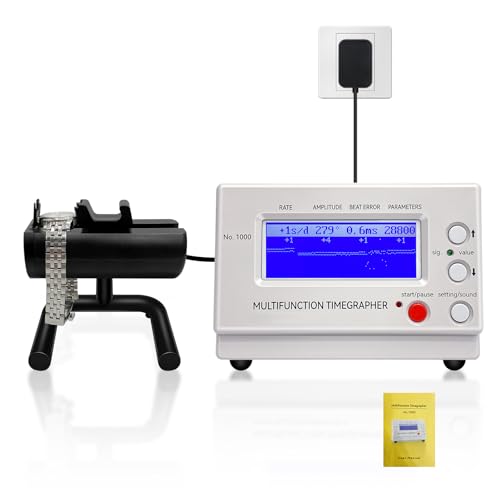
- Tests six key movement metrics
- Automatic and manual beat selection
- Supports one to six measurement directions
Best For: Detailed mechanical-watch diagnosis
Best Straightforward Workbench Pick

- Live rate and amplitude readouts
- Automatic beat range to 43,200
- Includes sensor and setup accessories
Best For: Routine home calibration and checks
Best Value Home Timegrapher – YaeTek NO.1000 Watch Tester
If you need a watch timing machine for home use, the YaeTek NO.1000 provides automatic readings for rate, amplitude, and beat error on mechanical watches. Its LCD display shows live results and a visual tic-tock waveform, while six testing positions and selectable sampling periods add flexibility for at-home checking.
Best For: Mechanical-watch collectors who want a versatile, easy-to-use home tester with adjustable sampling.
Pros:
- Automatically calculates rate, amplitude, and beat error.
- LCD screen provides live readings and moving visual waveform lines.
- Offers six testing positions and sampling periods from 2 to 60 seconds.
- Supports 110V-220V power with a US plug.
Cons:
- The supplied notes specify mechanical-watch use, so it is not a general watch tester.
- Its 3-inch display is smaller than larger-screen alternatives.
With broad adjustment options and straightforward automatic measurements, this is a practical choice for hobbyists building a home timing setup.
Compact Collector Pick – NO.1000 Multifunction Timegrapher
For shoppers comparing a watch timing machine for home use, this compact NO.1000 timegrapher is designed for mechanical watches and uses a corded electric power source. Its coaxial test compatibility and multifunction design suit both watch collectors and professional watchmaking tasks.
Best For: Collectors who want a compact, corded tester for almost all mechanical watches.
Pros:
- Designed to test almost all mechanical watches.
- Supports coaxial testing.
- Compact modern form measuring 6.77 x 1.57 x 4.49 inches.
- Uses corded electric power and has CE specification compliance.
Cons:
- The supplied notes do not list specific amplitude, rate, or beat-error display details.
- It requires a corded power connection rather than battery operation.
This model emphasizes compactness and broad mechanical-watch compatibility, making it a sensible straightforward option when you do not need the expanded specifications listed for newer timegraphers.
Large-Screen Upgrade – No.1900 Watch Timegrapher
The No.1900 is a strong candidate if your watch timing machine for home use should show several measurements clearly at once. Its larger LCD screen displays live rate, amplitude, beat error, beat, and lift angle readings, and the unit is designed for almost all mechanical watches, including coaxial models.
Best For: Home collectors and hobbyists who prioritize a larger, more detailed display.
Pros:
- Displays rate, amplitude, beat error, beat, and lift angle.
- Uses a larger screen than the No.1000 according to the supplied notes.
- Works with almost all mechanical watches, including coaxial watches.
- Includes a one-year warranty and customer service support.
Cons:
- The supplied notes do not provide specific sampling-period or rate-precision figures.
- It uses AC power, so placement near an outlet is required.
Its expanded live readout and stated compatibility make the No.1900 particularly appealing for users who want more information visible during each measurement.
Best for PC Data Transfer – Adjustable USB/RS232 Timegrapher
This watch timing machine for home use stands out for computer connectivity and adjustable positioning. It measures daily rate, amplitude, beat error, signal value, polarisation, oscillation frequency, and waveform, while USB/RS232 data transfer helps users move results to compatible tablets, laptops, and desktops.
Best For: Hobbyists who want broader analysis features, adjustable watch support, and computer-based data handling.
Pros:
- Supports daily rate, amplitude, beat error, waveform, and additional signal analysis.
- Offers USB/RS232 data transfer to compatible computers and tablets.
- Sliding removable jaws adjust to various dial sizes.
- A red indicator light shows when the device is powered on.
Cons:
- The supplied notes do not specify the included power adapter or plug type.
- Computer data transfer may require a compatible connection and device.
- The product notes do not identify supported watch types beyond its mechanical-watch calibration purpose.
Choose this model when connectivity and measurement depth matter more than a basic standalone tester; its adjustable clips also make secure positioning easier across different dial sizes.
Professional-Ready Pick – MTG NO.1900 Coaxial Timegrapher
OTOOLWORLD New Coaxial MTG Watch Tester Timing Multifunction Timegrapher LCD Screen NO.1900
Check Price On AmazonIf you want a watch timing machine for home use that can also suit more advanced work, the MTG NO.1900 offers a larger LCD screen and compatibility with almost all mechanical watches, including coaxial watches. Its corded design and adaptable plug options make it practical for a dedicated home bench.
Best For: Home watch collectors and experienced users who want clearer readings and coaxial-watch compatibility.
Pros:
- Larger LCD screen than the NO.1000 for easier viewing.
- Works with almost all mechanical watches and is designed to work especially well with coaxial watches.
- Multi-purpose design suitable for watchmakers and collectors.
- Supports 100V–240V power and includes exchange plug options for several regions.
Cons:
- Corded electric operation limits use away from an outlet.
- Its broader capabilities may be more than a casual user needs.
The NO.1900 is the stronger choice when screen visibility and broad mechanical-watch compatibility matter. It is particularly appealing for users who work with coaxial movements at home.
Beginner-Friendly Choice – TICFROG NO.1000 Watch Timegrapher
The TICFROG NO.1000 is a practical watch timing machine for home use and beginner watchmaking. It measures rate, beat error, and amplitude, presenting results graphically and numerically so you can assess a mechanical watch’s timekeeping behavior.
Best For: Beginners who want an essential mechanical-watch tester with straightforward readings and included accessories.
Pros:
- Measures rate, beat error, and balance-wheel amplitude.
- Displays results both graphically and numerically.
- Automatic signal-level adjustment supports convenient testing.
- Includes a sensor, US adapter, user manual, and watch-cleaning cloth.
Cons:
- Designed for mechanical manual watches rather than quartz movements.
- Users may need to consult the manual to understand the measurements and advanced functions.
With its core timing measurements and beginner-oriented feature set, the NO.1000 is a sensible entry point for home users learning to evaluate mechanical-watch accuracy.
Quartz Repair Multitool – Pilipane QD20 Quartz Movement Tester
For home users focused on quartz watches, the Pilipane QD20 is a versatile watch timing machine for home use that combines movement testing with battery checking and demagnetizing. Its ABS-and-metal construction is intended for home repair spaces as well as small repair shops.
Best For: Quartz-watch owners and home repairers who need movement, battery, and demagnetizer functions in one device.
Pros:
- Tests quartz movement operation and detects abnormalities in real time.
- Checks lithium and silver oxide watch batteries.
- Built-in demagnetizer helps address time errors caused by magnetic interference.
- Durable ABS and metal construction is designed for home or shop use.
Cons:
- Designed for quartz movements, not mechanical-watch timegrapher testing.
- Has no stated warranty.
The QD20 stands out for breadth rather than dedicated mechanical timing analysis. Choose it when battery testing, quartz diagnostics, and demagnetizing are more useful than traditional mechanical timegrapher measurements.
Best Display Upgrade – TICFROG No.1900 Timegrapher
If you want a watch timing machine for home use with a more informative display, the TICFROG No.1900 adds a high-resolution color screen and separate entrance- and exit-ping traces. It measures rate deviation, amplitude, and beat error while showing beat number and lift angle.
Best For: Home watch collectors, hobbyists, and watchmakers who want clearer visual feedback for adjustment and troubleshooting.
Pros:
- Color display shows two traces for easier beat-error analysis.
- Measures rate deviation, amplitude, and beat error.
- Supports one to six measuring positions and 100V–240V AC power.
- Includes a sensor, US adapter, manual, and cleaning cloth.
Cons:
- Its feature set may be more than casual users need.
- The supplied notes do not specify a compact battery-powered option.
The No.1900 is a strong choice when display clarity matters. Its color traces and broad measurement functions make it particularly useful for diagnosing and calibrating mechanical or coaxial watches at a home workbench.
Best Precision Features – No.1000 Professional Timegrapher
For a watch timing machine for home use focused on detailed movement testing, this No.1000 timegrapher covers daily rate, beat amplitude, polarity, beat, lift angle, and period. Its acoustic sensing system and selectable sampling settings support more involved mechanical-watch diagnosis.
Best For: Enthusiasts, technicians, and makers who need a broad set of measurements and manual control over testing parameters.
Pros:
- Measures daily rate, amplitude, polarity, beat, lift angle, and period.
- Offers automatic standard-beat detection and manual special-beat selection.
- Supports two- to 60-second sampling periods and one to six directions.
- Uses a stable zinc-alloy microphone base and supports 100V–240V input.
Cons:
- The 192×64-pixel display is less advanced than a high-resolution color screen.
- Its extensive settings may take time for beginners to learn.
- The listed warranty is 365 days.
This model emphasizes measurement depth and control rather than presentation. It is a practical fit for a home bench that handles varied mechanical movements and benefits from polarity and sampling information.
Best Straightforward Workbench Pick – No.1000 Watch Tester
This No.1000 is a straightforward watch timing machine for home use that displays rate, amplitude, beat error, beat, and lift angle in real time. Automatic beat settings from 12,000 to 43,200, plus manual settings, make it suitable for checking a range of mechanical movements.
Best For: Amateur watchmakers and technicians seeking an accessible timing tester for routine performance checks.
Pros:
- Shows key timing data on a live digital LCD display.
- Supports a wide automatic beat range from 12,000 to 43,200.
- Includes the timegrapher, sensor, US adapter, manual, and cleaning cloth.
- Designed for mechanical-watch calibration and workbench testing.
Cons:
- It is intended for mechanical watches and is not described as a general-purpose tester.
- The supplied notes do not list battery operation.
- It has no water-resistance rating.
Choose this version if you want the core readouts without prioritizing the No.1900’s color-trace display. Its live measurements, broad beat support, and included accessories make it a sensible starting point for routine home calibration.
How We Picked the Best Watch Timing Machine for Home Use
We focused on the functions that matter during home watch testing: daily rate, beat error, amplitude, beat frequency, display readability, acoustic pickup design, and ease of positioning a watch. We also considered whether each unit is aimed primarily at mechanical watches, includes broader testing functions, or is better suited to a repair bench than occasional hobby use.
Because marketplace listings can vary by seller, verify the included power adapter, pickup, instructions, software or printing features, and supported movement frequencies before ordering. A timegrapher is a diagnostic tool, not a substitute for cleaning, lubrication, or professional servicing.
Quick Comparison
| Type | Best For | What to Check |
|---|---|---|
| No. 1000 timegrapher | Routine mechanical-watch testing | Display clarity, pickup stability, and frequency settings |
| No. 1900 timegrapher | More visible bench diagnostics | LCD layout, measurement modes, and included accessories |
| Multifunction tester | Hobbyists testing several watch types | Actual supported movement and quartz functions |
| Quartz-focused tester | Quartz troubleshooting and home repair | Battery, demagnetizer, and movement compatibility |
Key Buying Factors for a Watch Timing Machine for Home Use
Measurements and Movement Compatibility
For mechanical watches, prioritize reliable readings for rate, beat error, amplitude, and beat frequency. Common mechanical frequencies include 18,000, 21,600, 28,800, and 36,000 vibrations per hour, but the unit must support the movement you plan to test. Do not assume “multifunction” means every watch type is covered.
Pickup and Positioning
An acoustic pickup should hold the case or bracelet securely and detect the escapement without excessive background noise. A stable rail or cradle makes it easier to test dial-up, dial-down, crown-up, crown-down, and other positions consistently. Repeatable placement is essential when comparing adjustments.
Screen, Controls, and Power
Choose a clear LCD or high-contrast display that lets you read several measurements at once. Simple controls are valuable when your hands are occupied. For home benches, check whether the unit uses mains power, USB power, or a supplied adapter, and confirm the plug standard before purchase.
Build and Included Accessories
A compact metal or reinforced housing can better tolerate regular bench use, while a lighter plastic unit may be adequate for occasional testing. Confirm that the pickup microphone, rail, cable, stand, and any demagnetizing accessories are included rather than shown only in promotional images.
Who Should Buy Which Watch Timing Machine for Home Use?
Choose a No. 1000-style model if you want an affordable, straightforward tester for checking rate and beat error during regulation. A No. 1900-style machine is a better fit if you prefer a larger or more informative LCD presentation and expect to use the tool frequently.
Choose a multifunction model if you work on varied watches and have confirmed its supported modes. The quartz-oriented QD20-style option makes more sense for a home repairer who also needs quartz movement testing or demagnetizing features. If you regulate valuable or complicated watches, use the timegrapher to guide diagnosis and confirm final work with professional service when necessary.