
Reliable water-resistance testing helps small watch workshops verify repairs, diagnose case leaks, and reduce the risk of returning a watch that is not properly sealed. The right tester should deliver repeatable results without taking up excessive bench space or requiring complicated operation.
We compare 10 watch pressure testers for small workshops, including dual-watch models, transparent-cylinder designs, and electric vacuum-pressure machines. Use the guide below to match pressure range, workflow, safety features, and budget to the work your bench handles most often.
Page Contents
- Best 10 Watch Pressure Testers for Small Workshops Picks for 2026
- Compact Dual-Station Tester – 10 Bar Watch Pressure Tester
- High-Range Alloy Workhorse – Dual Watch Water Tester
- Bubble-Check Professional – 6.0 Bar Watch Leak Detector
- Simple Dual-Case Checker – Ejoyous Underwater Watch Tester
- Workshop Essential – Dual-Watch Glass Pressure Tester
- Shop Efficiency Pick – 10-Bar Dual-Watch Tester
- Automation Upgrade – Electric Dual-Watch Tester
- Compact Dual-Case Tester – 10 Bar Watch Pressure Tester
- Ergonomic Manual Tester – Dual-Watch Underwater Pressure Tester
- Workshop Visibility Pick – Dual-Watch Air Pressure Tester
- How We Picked the Best Watch Pressure Testers for Small Workshops
- Quick Comparison
- Key Buying Factors for Watch Pressure Testers for Small Workshops
- Who Should Buy Which Watch Pressure Testers for Small Workshops?
Best 10 Watch Pressure Testers for Small Workshops Picks for 2026
Compact Dual-Station Tester

- Tests two watches at once
- Transparent cylinder and pressure dial
- Compact aluminum, glass, and rubber build
Best For: Small repair shops needing visible, space-saving dual-watch testing
High-Range Alloy Workhorse

- 0.3–6.0 bar stated test range
- Tests two watches simultaneously
- Compact alloy construction for storage or transport
Best For: Busy repair benches needing broad-range dual-watch testing
Bubble-Check Professional
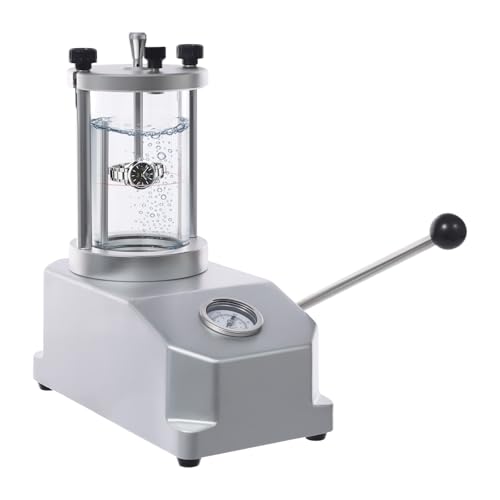
- 0.3–6.0 bar testing with 10 bar maximum cylinder pressure
- Manual lever and exhaust-button operation
- Transparent chamber for bubble-based leak checks
Best For: Shops wanting easy visual testing across quartz and mechanical watches
Simple Dual-Case Checker
Ejoyous Underwater Watch Tester

- Tests two watch cases at once
- Uses water immersion and bubble observation
- Transparent cylinder supports leak-location checks
Best For: Basic dual-watch seal checks in small repair operations
Workshop Essential
Dual-Watch Glass Pressure Tester

- 0.3–6.0 bar air-pressure range
- Transparent chamber with large gauge
- Tests two watches simultaneously
Best For: Small repair shops prioritizing clear manual testing
Shop Efficiency Pick
- Up to 10 bar cylinder pressure
- Dual-watch testing saves bench time
- Compact and ready to use
Best For: Space-conscious workshops needing simple setup
Automation Upgrade

- Electric vacuum-pressure operation
- Tests two watches simultaneously
- Includes power supply and clear tank
Best For: Workspaces prioritizing faster electric testing
Compact Dual-Case Tester

- Tests two watches at once
- Transparent cylinder for leak observation
- Adjustable up to 6 ATM
Best For: Small workshops handling routine tests on watches rated up to 6 ATM
Ergonomic Manual Tester
Dual-Watch Underwater Pressure Tester

- Manual dual-watch testing
- Large analog pressure dial
- Compact aluminum-and-glass body
Best For: Small repair shops needing a compact tester for compatible mechanical and quartz watches
Workshop Visibility Pick
Dual-Watch Air Pressure Tester

- Tests two watches simultaneously
- Transparent cylinder and oversized gauge
- Compact glass-and-aluminum construction
Best For: Small workshops wanting visible pressure testing for compatible watch sizes
Compact Dual-Station Tester – 10 Bar Watch Pressure Tester
For small workshops seeking watch pressure testers for small workshops, this compact model offers a transparent chamber, a readable pressure dial, and capacity for testing two watches at once. Its aluminum, glass, and rubber construction is sized for home, shop, and repair use.
Best For: Small watch shops and repair benches that need dual-watch testing in a space-saving format.
Pros:
- Tests two watches simultaneously to support faster workflow.
- Transparent glass cylinder helps reveal where a case may leak.
- Compact 9.5 x 5.5 x 10.6-inch design fits limited bench space.
Cons:
- The listed air-pressure test range is 0.3–0.6 bar, which is narrower than some comparable testers.
- Maximum case dimensions are limited to 2.6 inches in diameter and 2.8 inches in height.
This is a practical choice when visibility, two-watch capacity, and compact storage matter more than a broad pressure range.
High-Range Alloy Workhorse – Dual Watch Water Tester
Advanced Watch Water Tool for Reliable Water Resistance Testing of Two Watches Simultaneously
Check Price On AmazonThis option suits watch pressure testers for small workshops that want a wider stated pressure range and simultaneous testing. Its transparent cylinder supports visual leak checking, while the alloy construction is designed for regular workshop use.
Best For: Repair businesses and experienced watchmakers who value dual testing and a 0.3–6.0 bar range.
Pros:
- Tests two watches simultaneously for improved workflow.
- Offers a stated 0.3–6.0 bar pressure test range.
- Compact 5.91 x 3.94 x 1.97-inch form is easy to store or transport.
Cons:
- The product notes do not provide a maximum case size.
- The listing uses generic product wording, so operating details may require confirmation.
Choose this model if pressure-range flexibility and portability are priorities, especially for a busy bench handling multiple watches.
Bubble-Check Professional – 6.0 Bar Watch Leak Detector
For watch pressure testers for small workshops, this manual tester combines a transparent cylinder with a shake-lever system and exhaust button. It supports visual bubble detection on quartz and mechanical watches and requires no assembly before use.
Best For: Home users and repair shops wanting straightforward, visible case-seal testing with broad pressure control.
Pros:
- Provides a stated 0.3–6.0 bar air-pressure range with 10 bar maximum cylinder pressure.
- Transparent construction supports continuous visual monitoring and bubble detection.
- Anti-slip foot pads and rounded edges promote stable operation.
- Includes a 360-day warranty description.
Cons:
- At 24 x 14 x 27 cm and 3.4 kg, it may need a dedicated bench location.
- Its manual shake-lever operation may be slower than powered equipment.
This is a well-rounded workshop tool when easy visual diagnosis, manual control, and compatibility with both quartz and mechanical watches are important.
Simple Dual-Case Checker – Ejoyous Underwater Watch Tester
Ejoyous Watch Tester, Watch Underwater Pressure Tester 2 Watches Case Pressure Test Machine
Check Price On AmazonThis Ejoyous model is a straightforward choice among watch pressure testers for small workshops, using water immersion and bubble observation to assess case seals. Its transparent cylinder and two-watch capacity can help small repair operations handle routine checks efficiently.
Best For: Watchmakers and repairers who need a basic visual seal check for two watches at a time.
Pros:
- Tests two watch cases simultaneously.
- Transparent cylinder helps identify the location of a leak.
- Water-immersion bubble method offers a quick way to assess seal condition.
Cons:
- The supplied notes do not specify a pressure range or physical dimensions.
- The listing does not describe a pressure gauge or detailed pressure-control system.
- Its notes identify a corded-electric power source, which may need clarification for this type of manual tester.
This model is most suitable for buyers who prioritize dual-watch capacity and simple bubble-based inspection, but should verify pressure-control details before purchase.
Workshop Essential – Dual-Watch Glass Pressure Tester
For small workshops comparing watch pressure testers, this manual model offers a durable, easy-to-monitor setup. Its transparent glass chamber, large pressure gauge, and 0.3–6.0 bar operating range support practical watch-case sealing checks.
Best For: Repair shops that need simultaneous testing for two quartz or mechanical watches.
Pros:
- Tests two watches at the same time to improve workflow.
- Transparent chamber and large gauge provide clear visual monitoring.
- Aluminum alloy, glass, and rubber construction is designed for repeated use.
- Soft rubber handle and stable base pads support comfortable operation.
Cons:
- Manual operation may be less convenient than an electric tester.
- Its stated capacity is limited to watches up to 2.6 inches in diameter and 2.8 inches in height.
This is a straightforward choice when visibility, dual-watch capacity, and sturdy construction matter more than automation.
Shop Efficiency Pick – 10-Bar Dual-Watch Tester
Among watch pressure testers for small workshops, this compact unit combines a 0.3–6.0 bar air-pressure range with a cylinder rated up to 10 bar. The transparent cylinder and clear dial help operators observe and adjust testing conditions.
Best For: Small workshops wanting a ready-to-use, space-conscious tester with dual-watch capacity.
Pros:
- Can test two watches simultaneously.
- Transparent glass cylinder helps identify potential case leakage areas.
- Compact 9.5 x 5.5 x 10.6-inch design is easier to store.
- Ships ready to use and requires no assembly.
Cons:
- Manual testing requires operator adjustment and observation.
- Watch capacity is limited to a maximum 2.6-inch diameter and 2.8-inch height.
Its combination of dual testing, compact dimensions, and no-assembly setup makes it a practical fit for a busy but space-limited repair bench.
Automation Upgrade – Electric Dual-Watch Tester
For workshops seeking a faster alternative to manual watch pressure testers, this electric vacuum-pressure machine is designed for simultaneous testing of two watches. Its aluminum alloy case, transparent tank, and included power supply provide a self-contained setup for routine water-resistance checks.
Best For: Small professional or personal workspaces that prefer electric operation and visual observation.
Pros:
- Electric vacuum-pressure system supports quicker testing.
- Tests two watches simultaneously for improved productivity.
- Electronic testing is performed without opening the watch case back.
- Transparent tank allows visual observation during operation.
Cons:
- Requires access to power through the included supply.
- The supplied notes do not specify an operating pressure range.
This model is the most automation-oriented option in the group, making it worth considering when convenience and throughput are priorities.
Compact Dual-Case Tester – 10 Bar Watch Pressure Tester
For small workshops looking for watch pressure testers, this battery-powered model offers a compact way to check case resistance. Its transparent cylinder helps you observe where a case may be leaking, while the adjustable 0.3–6.0 bar range supports watches rated up to 6 ATM.
Best For: Small repair benches testing up to two watches at once, provided the watches are rated no higher than 6 ATM.
Pros:
- Tests two watches simultaneously.
- Transparent cylinder supports visual leak observation.
- Adjustable air pressure up to 6 ATM.
- Compact 9.45 × 5.51 × 10.63-inch design.
Cons:
- Testing is limited to watches rated at or below 6 ATM.
- Supplied notes do not specify a higher-capacity workshop calibration system.
This is a practical option when space and throughput matter, especially for routine case checks on smaller jobs. Confirm the watch’s water-resistance rating before testing.
Ergonomic Manual Tester – Dual-Watch Underwater Pressure Tester
Among watch pressure testers for small workshops, this manual unit emphasizes straightforward operation and compact storage. Its transparent glass cylinder and large analog dial let you monitor and adjust pressure while testing two watches together.
Best For: Watch repairers who want a manual, space-saving tester for most mechanical and quartz watches within its 2.6-inch diameter and 2.8-inch height limits.
Pros:
- Tests two watches at the same time.
- Transparent cylinder helps reveal possible case leaks.
- Large pressure dial is easy to observe and adjust.
- Compact aluminum-and-glass construction measures 9.5 × 5.5 × 10.6 inches.
Cons:
- Manual operation requires the user to generate and adjust pressure.
- Watch fit is limited by the stated 2.6-inch maximum diameter and 2.8-inch height.
- The supplied specifications contain inconsistent pressure-range wording, so verify the operating range before purchase.
The soft rubber handle and long lever suit repeated bench use, while the compact footprint is useful where storage is limited. Check case dimensions and the intended test range for each watch.
Workshop Visibility Pick – Dual-Watch Air Pressure Tester
This dual-watch model is designed for small workshops that need clear visual monitoring during pressure checks. The transparent glass cylinder, oversized gauge, and stated 0.3–6.0 bar air-pressure range support hands-on testing while keeping the unit compact.
Best For: Repair benches that prioritize visible testing, two-watch throughput, and compatibility with watches up to 2.6 inches in diameter and 2.8 inches in height.
Pros:
- Supports simultaneous testing of two watches.
- Transparent cylinder helps identify possible case leaks.
- Oversized gauge makes pressure monitoring easier.
- Glass and aluminum-alloy construction is compact and durable.
Cons:
- Physical watch size is limited to the stated cylinder dimensions.
- The product notes describe the working range as 0.3–0.6 bar in one bullet despite the 0.3–6.0 bar title, so confirm the specification before relying on it.
Its visibility-focused design and small 9.5 × 5.5 × 10.6-inch footprint make it appealing for crowded benches. Because the supplied pressure details conflict, verify the range and intended applications before ordering.
How We Picked the Best Watch Pressure Testers for Small Workshops
We focused on the features that matter most in a compact repair environment: usable pressure range, support for testing one or two watches, readable controls, construction quality, and how easily the tester fits into a repeatable workflow. We also considered whether a model uses a manual or electric process, whether the chamber offers clear visibility, and whether its design appears practical for routine case and seal checks.
Pressure ratings are useful for comparison, but they should never be treated as permission to exceed a watch manufacturer’s specifications. Testing must follow the watchmaker’s method and the equipment’s instructions.
Quick Comparison
- Best for higher-volume benches: Dual-watch machines can test two cases at once and reduce handling between jobs.
- Best for visual monitoring: Transparent-cylinder models make the chamber and test process easier to observe.
- Best for straightforward operation: Manual pressure testers generally have fewer electronic parts and can suit basic service work.
- Best for consistent powered testing: Electric vacuum-pressure models may be convenient when the workshop performs frequent, standardized checks.
- Best for flexible testing: Models covering approximately 0.3 to 6 bar or up to 10 bar offer useful range, provided the operator stays within safe limits.
Key Buying Factors for Watch Pressure Testers for Small Workshops
Pressure Range and Test Method
Choose a tester whose range matches the watches you service. Some machines emphasize air-pressure testing, while others combine vacuum and pressure stages. A broader range can improve flexibility, but accuracy and controlled adjustment matter more than the highest advertised number.
Capacity and Bench Footprint
Dual-watch holders are valuable when you regularly service multiple pieces, but they may require more bench space. Check the machine’s dimensions, chamber clearance, and access around the controls before buying.
Readability and Control
A clear gauge, stable pressure adjustment, and easy-to-read markings help prevent mistakes. Transparent chambers are especially useful for confirming positioning and observing the test, while electric units should have dependable switches and straightforward settings.
Build Quality and Maintenance
Look for a sturdy case, secure seals, a reliable lid or chamber closure, and components that can be cleaned or replaced. A pressure tester is only useful when its own seals and gauge remain dependable, so include calibration and inspection in your workshop routine.
Who Should Buy Which Watch Pressure Testers for Small Workshops?
Choose a dual-watch tester if your workshop handles regular battery, gasket, crystal, or caseback work and saving setup time matters. Choose a transparent-cylinder design if visibility and hands-on monitoring are priorities. Choose a manual model for occasional testing, a lower-complexity bench, or a preference for fewer electronic components. Choose an electric vacuum-pressure machine when repeatability and faster operation justify the added cost and maintenance.
For most small workshops, the best choice is not simply the model with the highest pressure rating. Prioritize a safe operating range, clear readings, adequate capacity, and a construction quality suited to the number of watches you test each week.