
Finding the right watch pressure tester can make water-resistance checks faster, more consistent, and easier to document. The 10 options in this roundup cover compact manual tools, dual-watch designs, and electric vacuum-pressure machines.
Use the guide below to compare pressure ranges, testing capacity, build quality, and everyday usability before choosing a tester for a repair bench, service counter, or serious hobby workspace.
Page Contents
- Best 10 Watch Pressure Testers Picks for 2026
- Professional Dual-Test Pick – 10-Bar Watch Pressure Tester
- Compact Workshop Choice – Dual-Watch Water Resistance Tester
- Ergonomic Repair-Shop Pick – Watch Case Pressure Tester
- Stable Professional Option – Watch Waterproof Pressure Tester
- Best Dual-Case Visibility – 10 Bar Watch Pressure Tester
- Best Ergonomic Manual Pick – Aluminum Watch Water-Resistance Tester
- Best Electric Operation – Dual Watch Vacuum Pressure Tester
- Practical Dual-Watch Tester – 10 Bar Watch Pressure Tester
- Professional Manual Tester – Dual-Watch Underwater Pressure Tester
- Clear-View Professional Tester – Dual-Watch Pressure Testing Machine
- How We Picked These Watch Pressure Testers
- Quick Comparison
- Key Buying Factors for Watch Pressure Testers
- Who Should Buy Which Watch Pressure Testers?
Best 10 Watch Pressure Testers Picks for 2026
Professional Dual-Test Pick

- 0.3–6.0 bar air test range with 10-bar cylinder
- Tests two watches simultaneously
- Transparent chamber and sturdy aluminum-glass build
Best For: Watchmakers prioritizing throughput and visual leak inspection
Compact Workshop Choice
Dual-Watch Water Resistance Tester

- 0.3–6.0 bar pressure test range
- Tests two watches simultaneously
- Compact alloy design with transparent cylinder
Best For: Users needing portable, space-conscious testing
Ergonomic Repair-Shop Pick
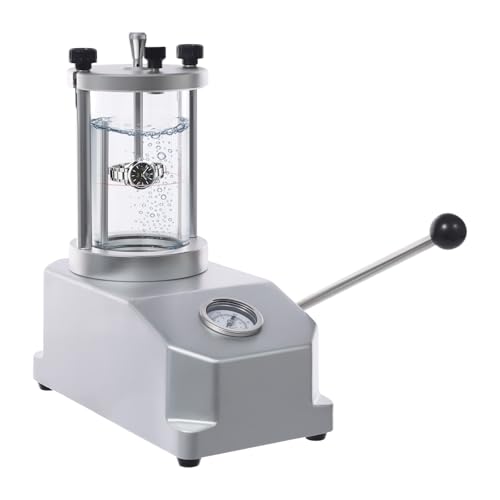
- Dual-watch testing for faster workflow
- Transparent chamber and analog pressure dial
- Comfortable long rubber handle
Best For: Repair users who prefer simple, ergonomic operation
Stable Professional Option
Watch Waterproof Pressure Tester
- 0.3–6.0 bar operating range
- Tests two watches at once
- Stable base, rubber handle, and clear chamber
Best For: Repair shops testing common quartz and mechanical watches
Best Dual-Case Visibility

- Tests two watches simultaneously
- Transparent cylinder and large pressure dial
- Compact design for shop or home use
Best For: Visible, efficient testing of mechanical and quartz watches
Best Ergonomic Manual Pick
Aluminum Watch Water-Resistance Tester
- Dual-watch testing improves workflow
- Durable glass and aluminum-alloy build
- Long rubberized handle for easier use
Best For: Repair benches needing comfortable, repeatable manual testing
Best Electric Operation
Dual Watch Vacuum Pressure Tester

- Electric vacuum-pressure testing
- Simultaneous testing of two watches
- Transparent tank and power supply included
Best For: Workshop users prioritizing powered, efficient testing
Practical Dual-Watch Tester

- Tests two watches at once
- Transparent cylinder for visual inspection
- Adjustable up to 6.0 bar
Best For: Workshop users testing watches up to 6 ATM
Professional Manual Tester
Dual-Watch Underwater Pressure Tester

- Manual dual-watch testing
- Large dial and transparent cylinder
- Fits most mechanical and quartz watches
Best For: Repair benches needing visible, efficient testing
Clear-View Professional Tester
Dual-Watch Pressure Testing Machine

- Dual-watch testing capability
- Large gauge with transparent cylinder
- Compact glass-and-aluminum construction
Best For: Compact repair spaces needing visual monitoring
Professional Dual-Test Pick – 10-Bar Watch Pressure Tester
For repair shops or serious hobbyists comparing watch pressure testers, this model combines a 0.3–6.0 bar air-pressure test range with a cylinder rated to 10 bar. Its dual-watch design and transparent chamber make it practical for evaluating sealing performance efficiently.
Best For: Watchmakers who need simultaneous testing, clear visual inspection, and a sturdy shop-ready unit.
Pros:
- Tests two watches at the same time to improve workflow.
- Transparent glass cylinder and large pressure dial support easy observation.
- Aluminum-alloy and glass construction, with non-slip feet and an ergonomic rubber handle.
- Supports watches up to 2.6 inches in diameter and 2.8 inches in height.
Cons:
- At 7.5 pounds, it is less convenient to move frequently.
- Its relatively large footprint may be more than occasional users need.
With no assembly required and support for most mechanical and quartz watches, this is a strong efficiency-focused choice for home workshops and professional repair counters.
Compact Workshop Choice – Dual-Watch Water Resistance Tester
Advanced Watch Water Tool for Reliable Water Resistance Testing of Two Watches Simultaneously
Check Price On AmazonThis compact option is a practical entry in watch pressure testers for users who want straightforward water-resistance checks. It tests two watches simultaneously, uses a 0.3–6.0 bar range, and provides a transparent cylinder for spotting leaks.
Best For: Amateurs and repair professionals seeking a portable, easy-to-operate dual-watch tester.
Pros:
- Simultaneously evaluates two watches for improved efficiency.
- Transparent cylinder helps identify sealing problems quickly.
- Compact design is easier to store or transport than larger workshop equipment.
- Alloy construction is designed for regular use.
Cons:
- The supplied notes do not specify the tester’s maximum watch dimensions.
- Its feature information is less detailed than some competing models.
If workspace and portability matter most, this model offers the core dual-watch testing functions without an oversized design, making it suitable for a range of repair settings.
Ergonomic Repair-Shop Pick – Watch Case Pressure Tester
Among watch pressure testers, this model emphasizes simple operation and comfortable handling. Its glass-and-aluminum construction, analog pressure dial, and transparent cylinder support visual case inspection while the dual-watch setup helps reduce testing time.
Best For: Watch repair users who value an ergonomic handle and straightforward analog monitoring.
Pros:
- Can test two watches simultaneously.
- Transparent chamber makes potential leaks easier to observe.
- Large dial allows pressure monitoring and adjustment during testing.
- Long rubberized handle is designed for a comfortable, non-slip grip.
Cons:
- The supplied specifications list a 0.3–0.6 bar range, which is narrower than the 0.3–6.0 bar range stated for several alternatives.
- At 7.5 pounds, it is not especially lightweight.
This is a sensible choice when handling comfort and clear analog observation are more important than portability or a broader stated pressure range.
Stable Professional Option – Watch Waterproof Pressure Tester
This watch pressure tester is built for repeated case-sealing checks, combining a 0.3–6.0 bar operating range with simultaneous testing of two watches. Its glass chamber and large gauge provide a clear way to monitor pressure while assessing water resistance.
Best For: Repair shops and manufacturers testing common quartz and mechanical watches in a stable setup.
Pros:
- Supports simultaneous testing of two watches.
- Transparent chamber enables real-time visual inspection.
- Fits most watches up to 2.6 inches in diameter and 2.8 inches in height.
- Rubber handle and stable base pads support comfortable, steady operation.
Cons:
- The product listing specifies no warranty.
- The supplied notes do not provide a cylinder pressure rating beyond the operating range.
Its broad compatibility and stable design make it a practical professional tool, though buyers who prioritize warranty coverage may want to compare alternatives first.
Best Dual-Case Visibility – 10 Bar Watch Pressure Tester
For watch shops, repair benches, or home users comparing watch pressure testers, this compact air-pressure model offers a practical way to evaluate waterproof performance. Its transparent cylinder and large dial make the testing process easier to observe, while the dual-watch capacity helps improve workflow.
Best For: Users who want visible, simultaneous testing for mechanical and quartz watches.
Pros:
- Tests two watches at the same time.
- Uses a 0.3–0.6 bar air-pressure range for different simulated water-use conditions.
- Transparent glass cylinder and large pressure dial support easy observation.
- Compact 9.5 × 5.5 × 10.6-inch design fits smaller workspaces.
Cons:
- The stated pressure range is limited to 0.3–0.6 bar.
- Its 2.6-inch maximum test diameter and 2.8-inch maximum test height may not suit every watch.
Choose this model if clear visual inspection and space-efficient dual testing matter most. Its aluminum, glass, and rubber construction is suited to routine waterproof checks at home or in a repair setting.
Best Ergonomic Manual Pick – Aluminum Watch Water-Resistance Tester
This watch pressure tester combines a 0.3–0.6 bar air-pressure range with a sturdy aluminum-alloy and glass build. It is designed for users who want to test two watches at once while keeping pressure adjustments and case inspection easy to follow.
Best For: Repair users who value durable construction and a comfortable, low-effort handle.
Pros:
- Can test two watches simultaneously.
- Supports testing across daily-use, swimming, and diving-style waterproof conditions within its stated range.
- Glass and aluminum-alloy construction is described as sturdy, impact-resistant, and wear-resistant.
- Soft rubber handle and long ergonomic grip are designed for easier operation.
Cons:
- The 0.3–0.6 bar air-pressure range may not cover every testing requirement.
- Its 2.6-inch diameter and 2.8-inch height limits require checking watch compatibility first.
This is a sensible option for a busy bench where repeated handling matters. The clear cylinder, large dial, and dual-watch setup make it practical for routine waterproofness checks without taking up excessive space.
Best Electric Operation – Dual Watch Vacuum Pressure Tester
Among watch pressure testers, this electric vacuum-pressure machine is aimed at users who prefer powered operation and simultaneous testing. Its aluminum-alloy case, transparent tank, and included power supply provide a ready-to-set-up solution for workshop or personal use.
Best For: Users seeking electric testing and two-watch capacity for more efficient bench work.
Pros:
- Electric vacuum-pressure system is designed for quick water-resistance testing.
- Tests two watches simultaneously.
- Tests without opening the case back, according to the supplied product information.
- Transparent tank allows visual observation during operation, and a power supply is included.
Cons:
- Requires access to a power supply for operation.
- The supplied notes do not specify a pressure range or detailed watch-size limits.
- The transparent tank is approximately 3.11 × 5.51 inches, so users should confirm fit before buying.
This model stands out when powered operation is more important than a manually adjusted pressure setup. Its dual-watch design and included power supply make it a practical productivity-focused choice, provided the tank dimensions suit the watches being tested.
Practical Dual-Watch Tester – 10 Bar Watch Pressure Tester
For watchmakers comparing watch pressure testers, this battery-powered model offers a straightforward way to check case water resistance. Its transparent cylinder helps you observe potential leak areas, while the adjustable air pressure reaches up to 6 ATM.
Best For: Testing two watches at once when working with watches rated up to 6 ATM.
Pros:
- Tests two watches simultaneously.
- Transparent cylinder makes potential problem areas easier to observe.
- Adjustable air pressure from 0.3 to 6.0 bar.
- Battery-powered operation is convenient for workshop use.
Cons:
- Testing is limited to watches rated no higher than 6 ATM.
- Its industrial-style construction may be more equipment than occasional users need.
This is a practical choice for users who prioritize dual-watch testing and visible inspection in a compact pressure-testing setup.
Professional Manual Tester – Dual-Watch Underwater Pressure Tester
Among watch pressure testers, this manual model is designed for repeatable case checks across different simulated underwater conditions. It accommodates two watches, uses a transparent glass cylinder, and includes a large pressure dial for monitoring and adjustment.
Best For: Watch repair users who want a manual dual-watch tester with broad compatibility for mechanical and quartz watches.
Pros:
- Tests two watches simultaneously to improve efficiency.
- Fits watches up to 2.6 inches in diameter and 2.8 inches in height.
- Transparent cylinder supports visual leak inspection.
- Ergonomic long handle and soft rubber grip are designed for easier operation.
Cons:
- Manual operation requires the user to generate and adjust pressure.
- The listed air pressure range is 0.3-0.6 bar, so users should verify it suits their testing needs.
- At 7.5 pounds, it is less portable than a lightweight hand tool.
With its compact aluminum-and-glass construction and dual-watch capacity, this tester suits repair benches where ease of viewing and efficient manual operation matter.
Clear-View Professional Tester – Dual-Watch Pressure Testing Machine
This watch pressure tester combines a compact glass-and-aluminum body with dual-watch testing and a large pressure gauge. The transparent cylinder lets you monitor the process directly, while the stated 0.3-0.6 bar testing range is intended to simulate everyday splash, swimming, and diving scenarios.
Best For: Users who want a durable, space-saving tester with clear visual monitoring and room for two watches.
Pros:
- Supports testing two watches at the same time.
- Transparent glass cylinder helps reveal possible case leaks.
- Large gauge enables real-time pressure monitoring.
- Compact 9.5 by 5.5 by 10.6-inch design is easy to store.
Cons:
- The listed testing range is 0.3-0.6 bar, which may not suit every pressure-testing application.
- Maximum watch capacity is limited to 2.6 inches in diameter and 2.8 inches in height.
- The product information lists a maximum cylinder pressure of 10 bar, which is different from the stated testing range.
This model is a sensible fit for a repair workspace that values clear inspection, compact storage, and higher throughput from dual-watch testing.
How We Picked These Watch Pressure Testers
We focused on the specifications that matter most during watch servicing: stated pressure range, support for one or two watches, measurement visibility, operating method, construction, and suitability for repeated use. Models advertising up to 10 bar or approximately 6 ATM received particular attention because they cover common water-resistance checks for many everyday watches.
We also considered practical details such as aluminum-alloy housings, dual-watch chambers, vacuum capability, control simplicity, and whether the design appears better suited to occasional home use or a professional repair bench. Always confirm the manufacturer’s instructions and remember that a pressure test does not replace proper inspection of gaskets, crowns, crystals, case backs, and seals.
Quick Comparison
| Feature | What to look for | Best suited to |
|---|---|---|
| Test capacity | Single or dual-watch chamber | Individual servicing or higher-throughput work |
| Pressure range | Ranges such as 0.3–6.0 bar or up to 10 bar | Routine checks across different watch ratings |
| Operating style | Manual air-pressure or electric vacuum-pressure operation | Simple maintenance or faster repeat testing |
| Construction | Rigid metal or aluminum-alloy case | Frequent bench use and improved durability |
Key Buying Factors for Watch Pressure Testers
Pressure Range and Measurement
Choose a range that matches the watches you service rather than assuming the highest number is always better. A clear gauge or display is essential for setting pressure accurately and spotting changes during the test. Check whether the listed units are bar, ATM, or both, since these values are related but not identical in every specification.
Single Versus Dual-Watch Testing
Dual-watch testers can improve efficiency when you regularly handle multiple pieces, but they may take up more bench space and require careful loading to maintain consistent results. A single-watch model can be more practical for occasional repairs, smaller work areas, or watches that need individualized handling.
Manual or Electric Operation
Manual testers are generally straightforward and may be easier to maintain. Electric vacuum-pressure models can reduce repetitive effort and offer a more streamlined workflow, but they add components that may require power, setup, or servicing. Review the control layout, included accessories, and operating instructions before buying.
Build Quality and Sealing
Look for a rigid housing, secure lid or chamber, reliable fittings, and a stable base. Construction quality affects not only durability but also confidence in repeatable readings. Verify the chamber dimensions and watch-holder design if you work with larger cases, bracelets, or unusual shapes.
Who Should Buy Which Watch Pressure Testers?
For occasional home repairs: Choose a compact manual tester with a clear gauge and a pressure range appropriate for your watches. Simplicity usually matters more than advanced automation.
For independent watchmakers: A dual-watch unit with a broad stated range can improve throughput while keeping the workflow relatively direct. Prioritize sturdy construction and easy-to-read controls.
For busy repair counters: Consider an electric vacuum-pressure model or another design built for repeated testing. Faster operation, durable materials, and accessible replacement parts may justify a higher price.
For specialized or high-value watches: Confirm the tester’s range, accuracy claims, chamber compatibility, and calibration guidance. Use the instrument as part of a complete water-resistance service rather than as the sole indication that a watch is safe for immersion.